
Timing a hummingbird feeder feels fussier than it is. There are really only two rules, plus a sense of when the birds show up in your part of the country, and one stubborn fall myth worth putting to rest. Get those straight and your feeder will be waiting when the first hummingbird of spring arrives, and still there for the last straggler of fall.
The Two Simple Rules
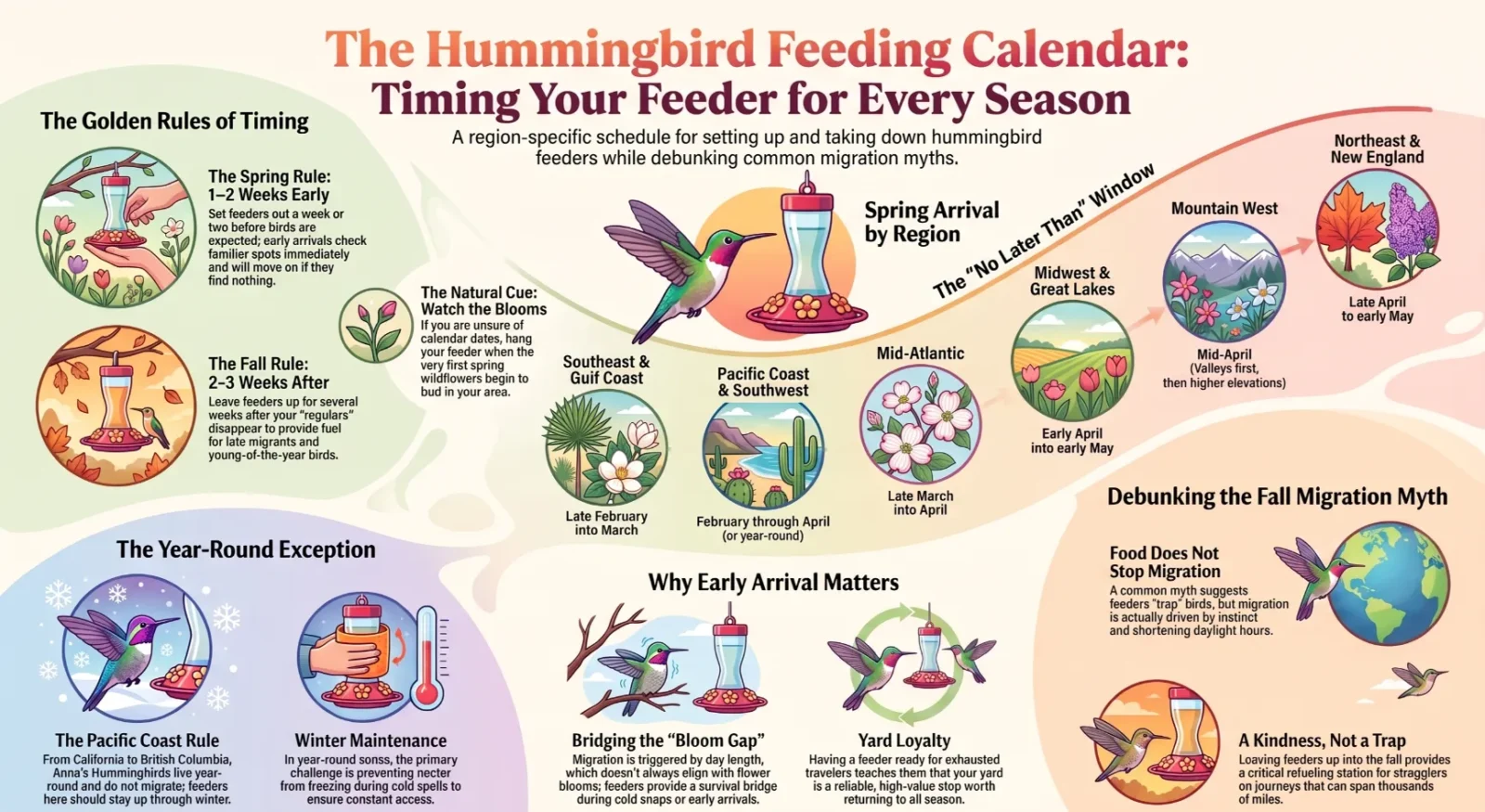
In spring, put your feeder out about one to two weeks before hummingbirds are expected to arrive in your area. Early arrivals often check familiar spots the moment they return, and a bird that finds nothing may not register your yard as a reliable stop. It is always better to be a little early than a little late.
In fall, leave your feeder up until about two to three weeks after you see your last hummingbird. The birds you stop seeing are your summer regulars; late migrants and young-of-the-year often keep passing through for weeks afterward, and a feeder left up helps them refuel.
That is the whole system. Everything else is just knowing your region.
When to Put Feeders Out, by Region
Arrival times sweep north as spring warms, so the right date depends on where you live. Treat these as your “no later than” targets, and feel free to put feeders out earlier, since hummingbirds increasingly arrive ahead of schedule.
Southeast and Gulf Coast: late February into March. Hummingbirds are among the first spring migrants here, so have feeders ready by the end of February. Parts of the Gulf Coast also hold wintering birds, so some feeders never come down at all.
Northeast and Midwest: mid-April to late May, depending how far north you are. The lower Midwest and mid-Atlantic see arrivals from mid-April, the Great Lakes and southern New England in late April to early May, and northern Maine, Vermont, New Hampshire and the Canadian range not until mid-to-late May. This is a single wave moving north over roughly six weeks, so your date depends on where you sit along it.
Rocky Mountains: mid-April in the valleys, May in the high country. Elevation matters more than latitude here. Birds arrive low first and follow the bloom upslope as the season advances, so a mountain meadow at 9,000 feet may not see its first Broad-tailed until well after the town below has had them for weeks.
Pacific Northwest: March and April for arriving Rufous, and year-round for Anna’s west of the Cascades. Have feeders out by early March on the coast.
California: year-round in most of the state. Anna’s does not leave, some Costa’s stay in the south, and the resident subspecies of Allen’s never migrates at all. Migratory Allen’s return unusually early, sometimes reaching breeding grounds in January.
Southwest: early spring, with a second and larger peak in late summer. Several species are present nearly year-round in the low desert, and the monsoon brings the biggest concentration of the year from late July into September.
If you are unsure of your local date, a good natural cue is to hang your feeder when the first spring wildflowers begin to bud.
One more thing about the West. Male hummingbirds in western states finish their part in breeding early and leave the lowlands by around early July, heading up into the mountains on their way south. If your feeder goes quiet in midsummer, that is usually why, and it is not a reason to take it down.
Why Early Matters
Hummingbirds begin migrating north when the days lengthen, and that timing does not always line up with when local flowers bloom. When birds arrive before the flowers open, or after a warm spell has caused blooms to fade early, a feeder can be the only reliable food along their route. Having yours out ahead of the first arrivals gives exhausted travelers an immediate meal and, just as importantly, teaches them that your yard is worth returning to all season.
Flowers do the same job better, and for longer. Planting for a continuous bloom is the more durable version of the same idea.
When to Take Feeders Down in Fall
Follow the same two-to-three-weeks-after-your-last-sighting rule, which lands most people somewhere between September and November depending on region. Northern areas empty out earlier, southern areas later. There is rarely any harm in leaving a feeder up longer if you are willing to keep the nectar fresh, and doing so can be a real help to late migrants. When you do take it down, give it a thorough cleaning before storing it, using the routine in our nectar and feeder guide.
The Fall Myth Worth Retiring
Every autumn, well-meaning people take their feeders down early, worried that a full feeder will tempt hummingbirds to linger too long and miss their migration. It will not. Hummingbird migration is triggered by the shortening length of the day and by instinct, not by the availability of food. A feeder does nothing to hold a bird back. What it does do is give late migrants and stragglers passing through a place to refuel on a journey that may run thousands of miles. Leaving it up is a kindness, not a trap.
This myth did real damage before it was disproved. Across the Gulf Coast in the 1970s, gardeners were told to take feeders down by a set date each autumn, and the result was that an entire population of western hummingbirds wintering in the Southeast went unnoticed for decades, simply because nobody was looking after October.
Year-Round Feeding on the Pacific Coast
There is one big exception to the whole put-out-and-take-down rhythm. Along the mild Pacific coast, from California up through coastal British Columbia, Anna’s Hummingbirds now live year-round and do not migrate away for winter. If you are in that band, keep your feeder up all year.
The main winter challenge is keeping the nectar from freezing, because a hummingbird spends a cold night in torpor and wakes at dawn with almost no reserve. Rotate two feeders, bring one in overnight, or use a warmer made for the purpose. Never add salt, alcohol, glycerin or anything else to lower the freezing point. Our Northwest guide covers the practical methods in detail.
Anywhere with a resident hummingbird population, feeders can stay out through every season.
Pinning Down Your Local Timing
Regional windows get you close, but the birds vary year to year with temperature and elevation. To sharpen your local date, watch the community sighting maps each spring. Journey North and Hummingbird Central both plot first arrivals as they move north, and the working rule is simple: when sightings appear consistently about two states south of you, hang your feeder within a few days.
Once you have seen a season or two in your own yard, you will know your personal date better than any map.
Frequently Asked Questions
When should I put out my hummingbird feeder?
About one to two weeks before hummingbirds typically arrive in your region, which ranges from late February on the Gulf Coast to mid-to-late May in northern New England and Canada. Earlier is safer than later.
When should I take my hummingbird feeder down?
Roughly two to three weeks after you see your last hummingbird of the season, generally between September and November depending on your area.
Will leaving my feeder up in fall stop hummingbirds from migrating?
No. Migration is driven by day length and instinct, not food. Leaving a feeder up actually helps late migrants refuel, so there is no need to take it down early.
Should I feed hummingbirds in winter?
In most of North America the birds are gone by winter. But along the mild Pacific coast, where Anna’s Hummingbirds stay year-round, and in parts of the Southwest and Gulf Coast, a winter feeder helps, as long as you keep the nectar from freezing.
Which part of North America sees hummingbirds last in spring?
Alaska and the high mountain west. Rufous Hummingbirds reach southeastern Alaska in March but spread north through the Gulf of Alaska into late April and May, and high-elevation Rocky Mountain meadows do not fill until May.
Why has my feeder gone quiet in July?
In the West, this usually means the males have left the lowlands for the mountains on their way south. Females and young are often still around, so keep the feeder fresh and up.
What if I put my feeder out and no hummingbirds come?
Early in the season this is normal; keep the nectar fresh and be patient. If birds are around but ignoring the feeder, clean it and replace the nectar, since spoiled nectar is a common reason they stay away.
Conclusion
Feeder timing comes down to two easy habits and a glance at your region: out a week or two before spring arrivals, down a few weeks after the last fall bird, and up all year if you live where hummingbirds do. Skip the fall worry entirely, because your feeder was never what kept them, and it may be exactly what helps the last travelers on their way.
Quiz: When to Put Out and Take Down Feeders
The quiz questions are grounded in ornithological and birding sources on migration and feeder timing. Key references are listed below:
Covers the northward progression of spring arrivals across the continent, males preceding females by about a week, and how warming has shifted departure timing from the wintering grounds.
Establishes that leaving feeders up does not delay migration, and documents the western hummingbirds that winter in the southeastern United States.
Covers the timing of spring arrivals, the increase in feeder visits once young-of-the-year fledge, and the early departure of western males from the lowlands into the mountains in summer.
Notes that hummingbirds reach the Gulf Coast by late February or March and move north through mid-to-late May, and that feeders should be ready early.
Documents the northern extreme of the continent’s hummingbird calendar. Rufous males reach southeastern Alaska in March and spread north along the coast, reaching Prince William Sound by the last week of April, with the Gulf of Alaska at the very edge of the breeding range.
Cornell’s feeder guidance, including how quickly sugar water ferments and why feeders should be emptied and cleaned on a schedule set by temperature.
Federal overview of species ranges across the continent, including which hummingbirds are year-round residents and which are long-distance migrants.