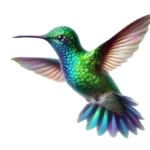
If you live along the Pacific Coast and see a hummingbird in January, this is your bird. The Anna’s Hummingbird is the West Coast’s year-round resident, hardy enough to hold its ground through winters that send every other North American hummingbird south. It is also the only hummingbird in North America whose entire head, crown and throat both, blazes rose-pink.
And it is a bird with a remarkable recent history. A century ago you would not have found one north of Southern California. Today it nests in British Columbia, and the reason is largely us.
Quick Facts
Scientific name: Calypte anna
Length: about 3.9 to 4.3 inches
Weight: around 4 to 4.5 grams, close to the weight of a US nickel
Range: Pacific Coast from Baja California to British Columbia, east into Arizona; largely non-migratory
Named for: Anna Masséna, Duchess of Rivoli, by French naturalist René Primevère Lesson in 1829
Conservation status: low concern, with populations rising by over 2 percent a year between 1966 and 2019
How to Identify an Anna’s Hummingbird
The male is unmistakable when the light is right. Both his crown and his throat are iridescent rose-pink to magenta, making him the only North American hummingbird with a fully red-pink head. His back is metallic emerald green, his underparts greyish. He is stocky and relatively large-headed for a hummingbird, with a short, straight bill.
As with all iridescent gorgets, that magenta vanishes at the wrong angle and the whole head reads as dark or black. If a hummingbird on the West Coast looks like it is wearing a black hood, wait for it to turn. The science of that effect is structural rather than pigmented.
The female is subtler but has a giveaway most female hummingbirds lack. She shows a small patch of red spotting in the centre of her throat, sometimes forming a tiny gorget of its own. That alone separates her from most other female hummingbirds, which have plain throats. Otherwise she is dull iridescent green above, dingy grey below, usually with a whitish mark over the eye.
Overall impression: grey and green, with no buff or orange tones anywhere. That absence is a useful field mark in itself, since the western Selasphorus hummingbirds are washed with rufous.
Similar Species
Costa’s Hummingbird is the closest relative and the main confusion. The male Costa’s gorget is violet-purple rather than rose-pink, and it flares much further down the sides of the neck into a pointed moustache. If an Anna’s-shaped bird looks more violet than rose, consider a Costa’s, or even an Anna’s and Costa’s hybrid, which do occur.
Black-chinned Hummingbird has a noticeably longer bill and a black throat with only a thin violet band.
Rufous and Allen’s are smaller and carry obvious orange tones that Anna’s never shows.
For the wider picture, the field guide to North American species sets out the whole cast.
Range, and a Range Expansion Worth Knowing About
In the first half of the twentieth century, Anna’s Hummingbird bred only in northern Baja California and Southern California. That was the whole of it.
Then the range began moving north and east, and it has not stopped. The species now breeds up the coast through Oregon and Washington into British Columbia, occurs regularly in southeast Alaska, and has pushed east into Arizona. It is now the defining hummingbird of both the Pacific Northwest and California.
Research points to two human causes. Eucalyptus and other exotic flowering trees, planted across California from the 1850s onward, supplied winter nectar where none had existed. Then backyard feeding grew. A 2017 study by Greig, Wood and Bonter linked the winter range expansion specifically to urbanisation and supplementary feeding.
It is a rare and cheering thing: a bird whose range grew because of what people did, rather than shrinking because of it. If you keep a feeder anywhere on the Pacific Coast, you are part of that story.
Anna’s favours open and scrubby habitat, chaparral, desert scrub and oak woodland, and takes readily to suburban yards, parks and gardens. Most individuals stay put year-round, though some southwestern birds make a modest east-west movement, with Arizona birds shifting toward the California coast after nesting.
The Feeders Are Changing the Bird Itself
This is the newest part of the story, and it goes further than range.
A study published in Global Change Biology in May 2025 examined roughly 400 museum specimens collected between 1861 and 2020. Over that period, Anna’s Hummingbird bills got measurably longer. The researchers tracked the spread of feeders by counting mentions in California newspaper archives, and bill length rose in step with feeder density.
A longer bill takes up more nectar from a reservoir that never runs dry, which is what a feeder is. The birds appear to be adapting to an artificial food source that did not exist two centuries ago.
The same study found the opposite pattern at the northern edge of the range. Birds there have shorter bills, possibly because a smaller bill loses less heat in cold weather.
Put together, that is a wild species visibly reshaped, within a century and a half, by garden feeders and ornamental planting. Few examples anywhere are this well documented.
The Winter Hummingbird
Along the coast, Anna’s is often the only hummingbird present in winter, and it is markedly more cold-hardy than its relatives. It survives freezing nights the way all hummingbirds do, by entering torpor, a deep dormancy that slows the body almost to a standstill until morning. Where it chooses to roost matters as much as the physiology.
Its willingness to take insects, spiders and tree sap as well as nectar may help through the lean months. That protein-rich side of the diet supports the metabolism cold weather demands.
If you host Anna’s through the winter, keep your feeder up all year. The practical challenge is simply keeping the nectar from freezing, which the nectar recipe and feeder guide covers. Timing elsewhere is a separate question, handled in when to put feeders out and take them down.
The Dive, and the Sound It Makes
The male’s courtship display is one of the great performances in North American birding. He hovers in front of the female, then climbs as high as 130 feet, and dives. At the bottom of the plunge he pulls up sharply and produces a loud, explosive pop or chirp. The whole sequence takes about twelve seconds.
For years that noise was assumed to be vocal. It is not. Research by Christopher Clark and Teresa Feo established that the sound is mechanical. The bird’s tail feathers vibrate as air rushes past them at the bottom of the dive, a mechanism called sonation. The Anna’s Hummingbird, in the title of their paper, chirps with its tail.
The dive itself produced two records. Clark measured a maximum of 27.3 metres per second, about 61 mph. That is not fast for a bird in absolute terms, but relative to body size it is 385 body lengths per second, the highest length-specific velocity recorded for any vertebrate.
The pull-out is the more startling number. The bird sustains centripetal accelerations approaching nine times gravity, which the paper describes as the highest reported for any vertebrate in a voluntary aerial manoeuvre, jet fighter pilots excepted. The aerodynamics that make this possible are the same ones the bird uses to hold station at a flower.
Males will aim the display at intruders as well as at females, including at people. If an Anna’s has ever dive-bombed you in the garden, you were being told off.
Then there is the singing. Most hummingbirds barely sing. Anna’s males sing more persistently and conspicuously than any other in North America, a thin, scratchy, buzzy song delivered from a perch for minutes on end. Those songs are complex and learned, which is rare among birds. Vocal learning is known in only three groups: songbirds, parrots and hummingbirds. More on how hummingbirds make sound, vocally and otherwise, is covered separately.
Breeding
Anna’s Hummingbirds nest remarkably early, sometimes beginning in December and typically well before spring, which is possible precisely because they do not migrate away. They raise two or three broods in a season.
The female does all the work, as in every hummingbird species. She builds a compact cup of plant fibres bound with spider silk, lined with plant down and sometimes feathers, and camouflaged outside with lichen and moss. The finished nest is about an inch tall and an inch and a half across. Nest sites are variable, usually 6 to 20 feet up on a branch, in vines, on a wire or under an eave.
The clutch is two eggs. Incubation runs about 16 days, and the young leave the nest roughly 20 days after hatching. The full breeding cycle is covered separately, and how long the survivors go on to live is a separate question again.
Attracting Anna’s Hummingbirds
They are among the easiest hummingbirds to attract, being both common and thoroughly comfortable around people.
Keep a clean feeder up year-round if you are within their range. Plant tubular-nectar flowers, including natives suited to your area. In the Pacific Northwest specifically, red-flowering currant (Ribes sanguineum) is an outstanding early-season shrub. Skip broad-spectrum pesticides so the insects and spiders they need remain available. The full guide to attracting hummingbirds goes into planting and placement in more detail.
Frequently Asked Questions
How do I identify an Anna’s Hummingbird?
Look for a stocky green-and-grey hummingbird with no orange tones. Males have a rose-pink crown and throat, the only North American hummingbird with a fully red-pink head. Females show a small red patch in the centre of an otherwise plain throat.
Do Anna’s Hummingbirds migrate?
Mostly not. They are year-round residents along the Pacific Coast, though some southwestern birds make short east-west movements after nesting.
Why do Anna’s Hummingbirds stay through winter?
They are unusually cold-hardy, surviving freezing nights through torpor, and the ornamental plantings and feeders of suburban gardens supply food when little else is blooming.
What is the popping sound a male makes when he dives?
It is made by his tail feathers vibrating in the rushing air at the bottom of the dive, not by his voice. Researchers call this sonation.
How fast is an Anna’s Hummingbird’s dive?
About 61 mph at maximum. That is not fast for a bird in absolute terms, but at 385 body lengths per second it is the highest length-specific velocity recorded for any vertebrate. The pull-out reaches nearly nine g.
Why has the Anna’s Hummingbird’s range expanded so much?
Exotic flowering plants in gardens and the growth of backyard feeding gave the species food and nesting sites far north of its original range. It has spread from Southern California to British Columbia in about a century. A 2025 study found that feeders have also lengthened the birds’ bills.
Should I feed Anna’s Hummingbirds in winter?
Yes, if they are resident in your area. Keep the feeder up all year and prevent the nectar from freezing.
Conclusion
The Anna’s Hummingbird is the West Coast’s constant. It is the one that does not leave, and that sings from a bare branch in February. It is also the one that flings itself 130 feet into the air and chirps with its tail on the way down. It is also a small, bright piece of evidence that what we plant and hang in our gardens changes where wild things can live. And now, it turns out, what shape they are. A hundred years ago this bird had no business being as far north as Vancouver. Now it spends the winter there.
Quiz: Anna’s Hummingbird
The quiz questions are grounded in peer-reviewed research and authoritative species accounts. Key references are listed below:
Species overview including the 130-foot dive display lasting about 12 seconds, and how the planting of exotic flowering trees allowed the species to greatly expand its breeding range from northern Baja and southern California.
Details the species as a permanent Pacific Coast resident, its December nesting, the buzzy perched song, nest construction and placement, and its northward and eastward range expansion since the 1950s.
The peer-reviewed study establishing that the loud chirp at the bottom of the male’s courtship dive is produced by tail feathers vibrating in the airflow, not by the bird’s voice.
Notes that males sing more conspicuously than any other North American hummingbird and that their songs are learned and complex, unusual among non-passerine birds, plus the origin of the species’ name.
Source for the female’s unusual red throat patch, the male as the only North American hummingbird with a full reddish crown, possible Anna’s–Costa’s hybrids, and the protein-rich diet that may aid cold tolerance.
Covers size, plumage, the unusual singing behavior among hummingbirds, and the species’ role as a pollinator across its western range.
The study linking the species’ winter range expansion specifically to urbanisation and backyard feeding, using two decades of citizen-science data from Project FeederWatch.
Around 400 museum specimens spanning 1861 to 2020 show bill length increasing in step with feeder density, and shorter bills at the cold northern edge of the range.
The dive measurements: a maximum of 27.3 metres per second, 385 body lengths per second, the highest length-specific velocity known for any vertebrate, and a pull-out approaching nine times gravity.