
Hummingbirds spent millions of years evolving defenses against the things that hunt them. They can out-turn a hawk, drive off a jay many times their size, and even nest under raptors for protection. What they never evolved defenses for is us. The greatest dangers hummingbirds face today are not natural predators at all. They are windows, outdoor cats, well-meaning but harmful feeding, pesticides, and shrinking habitat. No amount of speed or vigilance prepares a bird for a pane of glass or a moldy feeder.
The sobering backdrop: North America has lost roughly 2.9 billion breeding birds since 1970, close to one bird in four. The encouraging part is that most of the threats on this page are fixable, and many of the fixes happen in your own yard. This guide walks through what actually harms hummingbirds and what you can do about each one.
For the natural predators hummingbirds face, and the remarkable ways they defend themselves, see the companion article.
1. Window and Glass Collisions
Birds do not see glass. They see the reflection of sky, trees, or garden, and they fly straight into it at full speed. Hummingbirds are especially prone to this. They are fast, they are fiercely territorial, and they chase rivals in headlong pursuit that can end at a window before either bird registers the danger. Feeders and flowering plants placed near reflective glass make the problem worse by drawing birds into the collision zone.
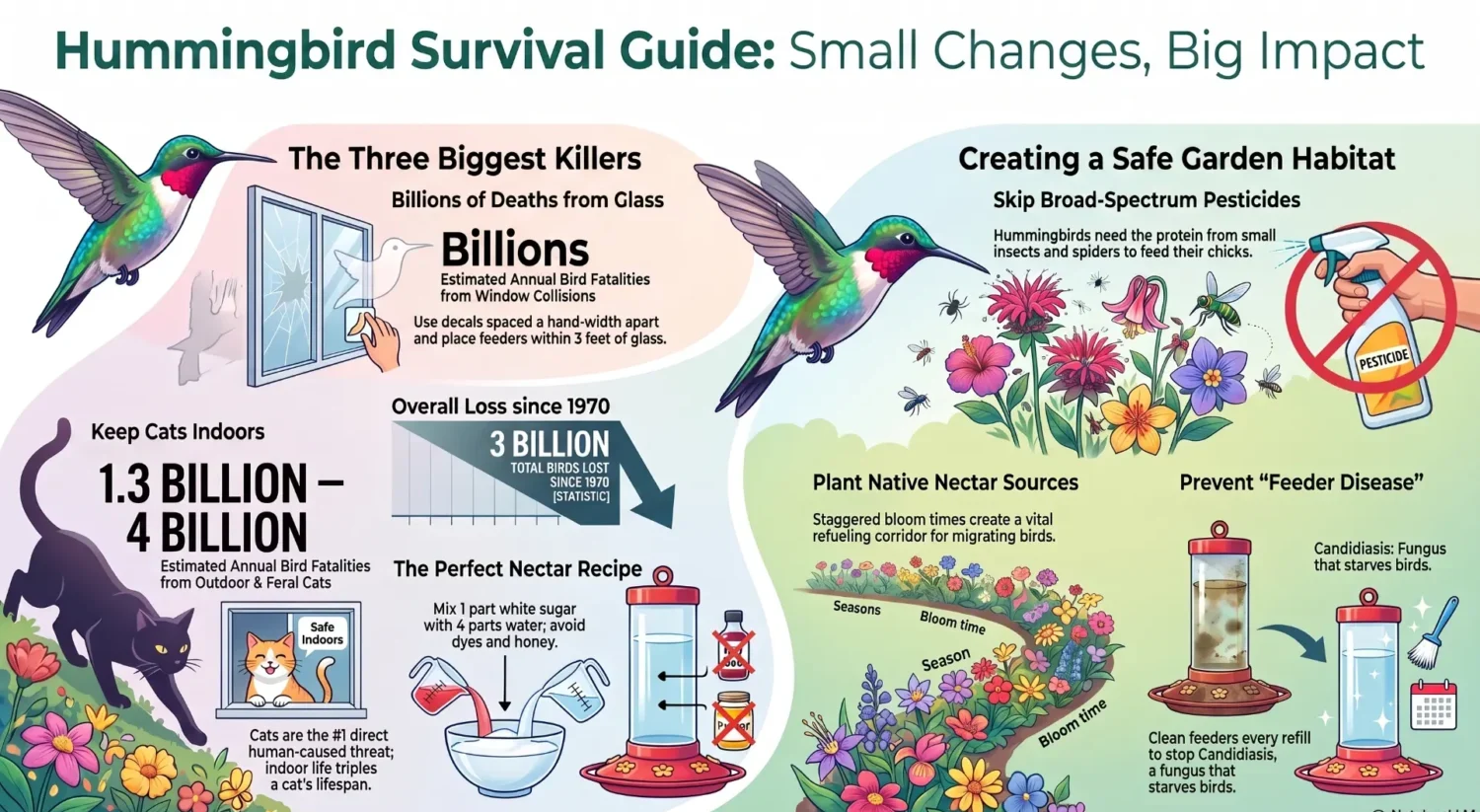
The scale is staggering, and it has been revised sharply upward. The long-standing systematic estimate put building collisions at 365 to 988 million birds a year in the United States, and crucially, 44 percent of that toll occurs at ordinary houses rather than office towers. More recent work has pushed the figure past a billion, with one peer-reviewed estimate ranging from 1.28 to 3.46 billion.
Part of the reason earlier counts fell short is that a bird which flies off after a strike was never counted. A 2024 study followed more than 3,000 collision-injured birds taken to wildlife rehabilitators and found that 60 percent died of their injuries even under expert care. Counting only the birds found dead at the base of a building misses most of what glass actually does.
How to help:
- Break up reflections on the windows birds hit most. Closely spaced dot or line patterns, external decals, one-way films, or screens all work. Spacing matters more than the design: marks should be no more than a hand’s width apart, so a bird sees no gap large enough to fly through.
- Move feeders to a smarter distance. Counterintuitively, placing a feeder within about three feet of a window is safer than the middle distance, because a startled bird cannot build up fatal speed. Alternatively, place it well away, more than thirty feet from the glass.
- Relocate feeders and potted flowers away from large reflective windows and glass doors.
2. Outdoor and Feral Cats
Free-ranging domestic cats are the single largest direct, human-caused source of bird death in North America. A landmark 2013 study by Loss, Will, and Marra estimated that cats kill somewhere between 1.3 and 4 billion birds a year in the United States, with roughly 69 percent of that toll coming from feral and unowned cats. Hummingbirds are vulnerable when they feed at low flowers and feeders, when they perch, and when they are in torpor and slow to react.
How to help:
- Keep cats indoors. It is the single most effective thing a pet owner can do for birds, and indoor cats live substantially longer, avoiding vehicles, fights, predators, and many infectious diseases.
- If your cat wants outdoor time, use a “catio,” a harness and leash, or a secure enclosure.
- Never place feeders or nectar plants near shrubs, fences, or ledges where a cat can lie in wait. Keep feeding stations in the open with clear sightlines.
3. Improper Feeding and Feeder-Borne Disease
This is the threat that catches kind people off guard, because it comes disguised as generosity. A neglected or badly stocked feeder does not just fail to help. It can actively kill the birds it attracts. The good news is that getting it right takes about five minutes and a few pantry items.
The recipe is one part plain white sugar to four parts water, with nothing else added: no dye, no honey, no substitutes. Our nectar recipe and cleaning guide covers mixing, feeder choice, and the cleaning routine in full.
Cleanliness is the part that matters most. In warm weather, sugar water begins to ferment within a day or two, and visible mold can appear within three to five days. Change the nectar every two to three days in mild weather and daily in heat, and clean the feeder every time you refill it.
What a sick hummingbird looks like. Two diseases spread at feeders, and both are worth recognising. Candidiasis is a fungal infection that swells the tongue until the bird cannot retract it or feed; the telltale sign is a hummingbird perched at a feeder for long spells without actually drinking. Avian pox is a virus that produces wart-like growths on the bill, feet, and around the eyes. If you see either, take the feeder down, clean it thoroughly, and leave it down for a couple of weeks so birds disperse. Both are covered in detail on our hummingbird health and diseases page, and if you find a bird that is grounded, weak, or unable to fly, read what to do with a sick or injured hummingbird before you touch it.
Two design points also reduce risk. Feeders that come completely apart can actually be cleaned; large multi-port reservoir feeders hide mold inside the ports and resist proper scrubbing. And several small feeders spaced apart beat one large one, because spacing cuts both the crowding that spreads pathogens and the territorial fighting that clusters birds together.
The rule of thumb: a dirty feeder is worse than no feeder at all.
4. Pesticides and Insecticides
Hummingbirds are not purely nectar drinkers. They rely on small insects and spiders for the protein, fat, and minerals that nectar lacks, and this matters most for females feeding growing chicks. Broad-spectrum insecticides wipe out that essential prey, and systemic pesticides can be taken up into the very flowers and nectar the birds feed from.
How to help: avoid broad-spectrum sprays in the garden, tolerate the small insects that hummingbirds hunt, and favor natural pest control. A yard with insects is a yard that can actually feed a hummingbird family.
5. Habitat Loss and Human Encroachment
Development, lawn monocultures, and the loss of native flowering plants steadily erase the nectar sources and nesting cover hummingbirds depend on. For migrating birds, this fragments the chain of blooming flowers they need to refuel along thousand-mile journeys.
How to help: plant native, nectar-rich flowers chosen so that something is always in bloom across the season. Leave shrubs and small trees for shelter and nesting, reduce lawn, and think of your yard as one link in a much longer corridor.
6. Climate Change and Severe Weather
Climate change threatens hummingbirds less by killing them directly and more by throwing their timing out of sync. As warming shifts flowers to bloom earlier, migrating hummingbirds, whose departure is cued by day length rather than temperature, can arrive to find their expected food already spent.
This phenological mismatch is best documented in the Rocky Mountains, where high-elevation plants now flower earlier while Broad-tailed Hummingbirds still arrive on a day-length schedule, and where the breeding season is short enough that there is no slack to absorb the difference.
Severe cold and storms are genuinely dangerous too, though this is one pressure hummingbirds have a real defense against: torpor, the deep nightly dormancy that lets them survive freezing nights.
How You Can Help: A Quick Checklist
- Keep cats indoors.
- Make your windows visible to birds with closely spaced decals, film, or screens, and place feeders either very close to glass or well away from it.
- Use the right nectar: one part white sugar to four parts water, with no dye, honey, or substitutes.
- Clean feeders every refill and change nectar every few days, more often in heat.
- Learn to spot a sick bird, and take the feeder down if you see one.
- Skip broad-spectrum pesticides.
- Plant native flowers with staggered bloom times and leave cover for nesting.
- Leave nests alone. Hummingbirds and their nests are protected by federal law, and disturbing an active nest is both illegal and dangerous for the chicks.
None of these asks much, and together they remove most of the dangers that a hummingbird cannot handle on its own.
Frequently Asked Questions
What kills the most hummingbirds?
Across all birds, habitat loss, outdoor cats, and window collisions cause the greatest human-related losses. For hummingbirds specifically, poorly maintained feeders add a preventable danger through fatal disease.
Is red dye bad for hummingbirds?
Its safety for hummingbirds has never been established, and it serves no purpose, since the feeder’s red parts already attract them. The safe choice is to leave it out entirely.
What is the correct hummingbird nectar ratio?
One part white granulated sugar to four parts water. No honey, no dye, no artificial sweeteners.
How often should I clean my hummingbird feeder?
Every time you refill it, and change the nectar every two to three days, or daily in hot weather when it ferments fastest.
Are hummingbird feeders bad for birds?
No, a clean feeder is a real help. A neglected one, though, can spread fatal fungal and viral diseases, so the commitment to cleaning is the price of feeding.
Do windows really kill hummingbirds?
Yes. Their speed and territorial chases make them frequent victims of collisions, and most collision deaths happen at ordinary houses rather than tall buildings. Breaking up reflections and placing feeders wisely prevents most strikes.
How do I know if a hummingbird at my feeder is sick?
Watch for a bird that perches at the feeder for long stretches without drinking, which can indicate a swollen tongue from candidiasis, or wart-like growths on the bill, feet, or around the eyes, which indicate avian pox. If you see either, take the feeder down and clean it.
Conclusion
Almost everything that seriously threatens a hummingbird today traces back to a human decision, which means almost every one of these threats can be undone by a different one. A cat kept inside, a window marked, a feeder cleaned, a patch of native flowers left to bloom. These are small acts, but for a bird that already survives against staggering odds, they are often the difference. The natural side of that survival story, the predators and the clever defenses, is told in a companion article.
Quiz: Threats to Hummingbirds
The quiz questions are grounded in peer-reviewed research and established conservation guidance. Key references are listed below:
The study documenting a net loss of approximately 2.9 billion breeding birds in North America since 1970, a 29 percent decline that provides the population context for every threat in this quiz.
The public summary of the Rosenberg study from the Cornell Lab and American Bird Conservancy, including the recommended everyday actions: making windows safer, keeping cats indoors, and protecting habitat.
The landmark systematic review estimating that free-ranging domestic cats kill between 1.3 and 4 billion birds annually in the United States, with the majority of that toll from feral and unowned cats.
Establishes that roughly 69 percent of cat-caused bird deaths come from feral or unowned cats, and that cats rank second only to habitat loss among human-related causes of bird mortality.
The systematic estimate long treated as the standard figure: 365 to 988 million birds killed annually by building collisions in the US, with 44 percent of that toll at residences rather than office towers.
Coverage of the PLOS ONE study that examined outcomes for more than 3,000 collision-injured birds taken to rehabilitators, and found that 60 percent died of their injuries even under expert care. Counting only birds found dead at the base of a building therefore undercounts the true toll substantially.
Veterinary account of how avian pox spreads through direct contact, contaminated feeders and perches, and biting mosquitoes, and why removing and disinfecting feeders helps control an outbreak.
Audubon’s feeder guidance, including cleaning frequency by temperature, the case against red dye, and why honey and other sweeteners must never be used.