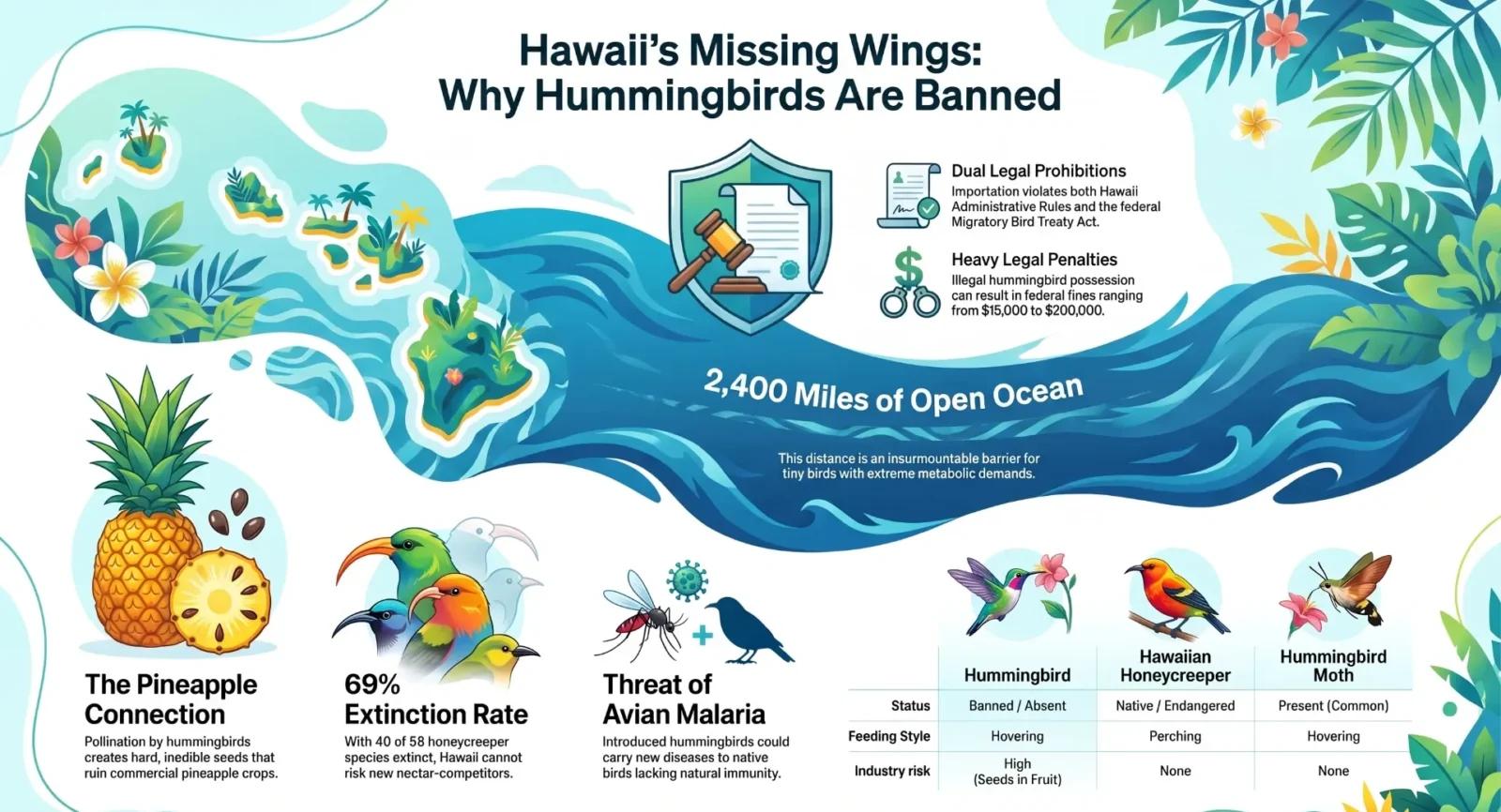
There are no hummingbirds in Hawaii because the 2,000-mile ocean distance is too vast for them to migrate across, and importing them is strictly illegal to protect both the commercial pineapple industry and endangered native Hawaiian birds.
Hawaii’s lush tropical landscapes, with their cascading flowers, warm temperatures and abundant nectar, could be perfect hummingbird habitat. Yet these remarkable aerial acrobats are completely absent from the island chain, and their absence is no accident. The story behind it touches on geology, evolutionary biology, agricultural economics and conservation law. It also turns on one of the most surprising connections in natural history: the relationship between hummingbirds and pineapples.
The Geographic Barrier: An Ocean Too Wide to Cross
Picture trying to fly from California to Hawaii. Now imagine doing it while weighing less than a penny, with a metabolism so fast you need to feed every ten to fifteen minutes just to stay alive. There are no flowers below you, no insects and nowhere to land.
That is the primary reason hummingbirds have never naturally colonised Hawaii. The Pacific presents an insurmountable barrier for a bird of this size and physiology, despite the fact that some hummingbirds are extraordinary long-distance migrants.
Hawaii is the world’s most isolated archipelago, sitting more than 2,000 miles from the nearest continent and approximately 2,400 miles from the California coastline. Its islands are the exposed peaks of volcanic mountains formed by a hot spot deep in the ocean floor. They were never connected to any mainland. Every species that lives there had to arrive by air, ocean drift or human introduction.
Hummingbirds, family Trochilidae, are native exclusively to the Americas and the Caribbean. More than 360 species exist, ranging from Alaska to Tierra del Fuego, but none have ever crossed either ocean to colonise another continent or distant island chain. About 15 species occur regularly in the United States and Canada, and the field guide to North American species covers them all.
Even the most accomplished long-distance migrant in the family, the Ruby-throated Hummingbird, would find the Pacific impossible. It crosses the Gulf of Mexico nonstop each spring and autumn, a journey of around 500 miles. Hawaii is nearly five times further, with no coastline at either end of the gap.
The Law: Why Hummingbirds Are Banned in Hawaii
Hawaii’s ban on hummingbirds is not a general wildlife restriction that happens to catch them in its net. They are named.
Hawaii Administrative Rules §4-71-6 is the state’s List of Prohibited Animals. Under the order Apodiformes it carries this entry:
Trochilidae (all species in family, except sexually dimorphic males for exhibition in government zoos only)
That is the whole hummingbird family, prohibited by name, administered by the Hawaii Department of Agriculture. The purpose is to protect the islands’ ecosystems, native species and agricultural industries from the risks posed by introduced animals.
The exception is worth noticing, because almost nobody mentions it. Males of species where the sexes look different may be imported for exhibition in government zoos. The logic is straightforward once you see it. A male alone cannot found a population, and sexually dimorphic species are the ones where you can be confident at a glance that a bird is male.
On top of the state rule, federal law adds a second layer. The Migratory Bird Treaty Act of 1918 makes it illegal throughout the United States to capture, possess, transport, sell or purchase hummingbirds without a federal permit. That covers their feathers, eggs and nests too. Penalties run to a fine of up to $15,000 and six months’ imprisonment for a misdemeanour. Commercial violations are felonies and are punished far more heavily. The full legal picture on both sides of the border is covered separately.
So bringing a hummingbird to Hawaii would breach state importation law and federal wildlife law at the same time.
The Pineapple Connection: The Agricultural Reason Behind the Ban
This is the part of the story that surprises almost everyone.
Pineapples and hummingbirds share a native homeland. Both originate in South America. Pineapples were first cultivated by the Guaraní peoples of Brazil and Paraguay, and hummingbirds pollinate wild pineapple plants, Ananas comosus, across their shared native range.
When a hummingbird pollinates a pineapple flower, the plant does what any pollinated plant does. It produces seeds. In the wild those seeds are essential. In a commercial pineapple operation they are a serious problem. Pollinated pineapples develop hard, densely packed seeds throughout the flesh. The seeds are unpleasant to eat and they make the fruit commercially undesirable. The seedless pineapple is what the market wants, and cross-pollination is what destroys it.
Hawaii’s pineapple industry at its peak supplied over 80 percent of the world’s canned pineapple. Growers went to considerable lengths to keep their crops seedless. The prospect of wild hummingbird populations pollinating pineapple flowers across the islands was, from the industry’s perspective, a catastrophe waiting to happen.
The pineapple explanation is the one most commonly given for the ban, and the horticulture behind it is real. How much the industry actually drove the rule is harder to document than the story usually admits. The prohibition sits within a broader regime that restricts a great many introduced animals for ecological reasons, and those reasons would be sufficient on their own. Treat the pineapple as a genuine and vivid part of the picture rather than the single cause.
The irony stands either way. A non-native fruit, imported to Hawaii by humans, is bound up in the exclusion of a bird that would have been its natural pollinator back home.
The Evolutionary Solution: Meet Hawaii’s Honeycreepers
Nature abhors a vacuum. In the absence of hummingbirds, Hawaii evolved its own nectar-feeding specialists through one of the most remarkable examples of adaptive radiation in the bird world.
Hawaiian honeycreepers descend from a single finch-like ancestor that arrived in Hawaii millions of years ago, likely blown off course during a Pacific storm. They are now placed within the finch family Fringillidae, in the tribe Drepanidini. Older sources treat them as a subfamily, Drepanidinae, so you will see both. From that one colonising lineage, isolation and varied environments drove the evolution of dozens of distinct species, each adapted to a different ecological niche.
Several evolved to fill the nectar-feeding and pollination roles that hummingbirds occupy in the Americas. They developed strikingly similar adaptations through convergent evolution, not because they are related to hummingbirds, but because the ecological pressures were the same.
The ʻIʻiwi (Drepanis coccinea), the scarlet honeycreeper, is the most iconic. It is brilliant red, with a dramatically curved salmon-pink bill shaped for probing the tubular flowers of native lobelias and ʻōhiʻa blossoms. It is the bird most often described as Hawaii’s hummingbird equivalent.
The ʻApapane (Himatione sanguinea) is the most abundant of the remaining honeycreepers. Crimson-bodied with a slightly curved bill, it is one of the most important pollinators of ʻōhiʻa lehua trees in Hawaiian forests.
The Hawaiʻi ʻamakihi (Chlorodrepanis virens) is a small, yellow-green bird with a gently curved bill. It is among the most ecologically flexible honeycreepers, and among the most likely to survive into the future.
Unlike hummingbirds, honeycreepers feed primarily while perching rather than hovering. It is a different energy strategy for the same ecological outcome. It is also a reminder that hummingbird flight is genuinely unusual rather than simply a good way to reach a flower. Hawaiian native plants co-evolved alongside these birds over millions of years, producing flowers tuned to honeycreeper bill shapes and feeding styles. Those relationships are precisely what an introduced hummingbird would disrupt.
The Conservation Crisis: Why Hawaii Cannot Afford a New Competitor
The honeycreeper story is one of evolutionary wonder and also one of the most acute conservation emergencies in the world.
Of roughly 58 known species of Hawaiian honeycreeper, about 40 are presumed extinct. That is an extinction rate near 69 percent for a single group, which makes Hawaiian honeycreepers one of the most threatened bird lineages on the planet. Around 18 species remain, and several are considered functionally doomed without dramatic intervention.
Avian malaria is the single greatest killer. The disease is caused by a blood parasite, Plasmodium relictum, spread by introduced mosquitoes that arrived in Hawaii in the early 19th century in the water barrels of sailing ships. Native Hawaiian birds had no evolutionary exposure and have little natural immunity. Honeycreepers that contract it die rapidly. As climate change warms Hawaii’s higher-elevation forests, the last refuges where mosquitoes have historically been too cold to survive, the remaining populations face a shrinking safe zone.
Introduced predators compound it. Rats, mongooses and feral cats take eggs, chicks and nesting adults, suppressing reproduction across all remaining species. The same predator pressures operate on hummingbirds on the mainland, but mainland birds evolved alongside their predators and Hawaiian birds did not.
Habitat loss from agricultural conversion, urban development and invasive plants has reduced and fragmented the native forest the honeycreepers depend on.
Against that backdrop, introducing hummingbirds would add a direct competitor for the nectar the remaining honeycreepers need. Introduced birds can also carry pathogens and parasites, and the diseases that circulate at feeders show how readily these move between birds. For populations already at the edge, a new competitor arriving alongside a new disease risk could be the final pressure.
The Cautionary Tales: Mongooses, Barn Owls, and the Cost of Getting It Wrong
Hawaii’s strict prohibition is informed by painful experience.
In 1883, small Indian mongooses (Urva auropunctata) were deliberately introduced to Hawaii’s sugar plantations to control rats. The logic seemed sound. The outcome was a disaster. Mongooses are active during the day and rats are primarily nocturnal, so the two species barely interacted. Instead the mongooses turned to ground-nesting birds, sea turtle eggs and native reptiles. They are now established on most of the main islands except Kauai and Lanai, and they remain a significant threat.
Barn owls were introduced in the 1950s for the same reason and with the same result. They proved ineffective against rats and preyed on native birds instead.
Both are now object lessons in the unintended consequences of introducing non-native species to island ecosystems. That is why the hummingbird prohibition is treated as non-negotiable, however benign the birds look to a mainland visitor who enjoys them at a backyard feeder.
What in Hawaii Looks Like a Hummingbird? The Hummingbird Moth
Visitors to Hawaii sometimes report seeing what they are certain is a hummingbird, only to be told by locals that it must have been something else. In most cases they have encountered a hawkmoth.
The species usually responsible is Macroglossum pyrrhosticta, an Asian hawkmoth introduced to Hawaii and known locally as both the hummingbird hawk moth and the Maile Pilau hornworm. Hawaii also has a native hawkmoth, the Hawaiian sphinx (Hyles calida).
The resemblance is genuinely striking. These are day-flying moths that hover in front of flowers to feed on nectar through a long coiled proboscis, exactly as a hummingbird would. The wings beat fast enough to produce an audible hum. Body shape, hovering posture and feeding behaviour are close enough that even experienced naturalists do a double-take.
The moth does not pollinate pineapples in commercially significant quantities. It lacks the bill and the foraging pattern that would drive effective cross-pollination, so it poses no agricultural threat. It is a legitimate pollinator of many Hawaiian flowering plants.
It is also a fine example of convergent evolution in behaviour. A moth, a hummingbird and a Hawaiian honeycreeper each arrived at hovering or nectar-feeding independently. Abundant tubular flowers offering high-energy rewards produce the same pressure whatever taxon responds to it.
The Future: Will Hummingbirds Ever Come to Hawaii?
Almost certainly not, and that is probably the right outcome for Hawaii’s ecosystems.
The Pacific will not shrink. No hummingbird species is evolving the capacity for a 2,400-mile transoceanic flight. Hawaii’s legal protections show no sign of being relaxed. If anything, as the extinction crisis facing the honeycreepers deepens and the value of protecting native plant-pollinator relationships becomes better understood, the case for keeping hummingbirds out grows stronger.
Climate change will keep reshaping Hawaii’s ecosystems in ways that are hard to predict, shifting mosquito ranges upslope, altering flowering seasons and fragmenting native forest. Conservation work, including captive breeding, predator control and mosquito-suppression technologies, offers some hope. All of it depends on keeping the introduced species list as short as possible, which is the same logic that drives conservation concern for hummingbirds themselves on the mainland.
The hummingbird will remain a mainland wonder. Hawaii will remain the extraordinary evolutionary experiment it has always been. Isolation, time and adaptive radiation produced solutions to common ecological challenges that look nothing like the rest of the world’s answers.
Frequently Asked Questions
Why are there no hummingbirds in Hawaii?
Two reasons. Hawaii’s extreme isolation, more than 2,000 miles of open Pacific from the nearest continent, makes natural colonisation impossible for a bird with hummingbird energy needs. And it is illegal to import them, under Hawaii Administrative Rules §4-71-6 and the federal Migratory Bird Treaty Act.
Are hummingbirds illegal in Hawaii?
Effectively yes. The whole family Trochilidae appears on Hawaii’s List of Prohibited Animals. The rule carries one narrow exception: sexually dimorphic males may be imported for exhibition in government zoos. For everyone else the answer is no.
Why are hummingbirds banned in Hawaii?
For ecological and agricultural reasons. Introduced hummingbirds could compete with endangered honeycreepers for nectar and disrupt co-evolved plant-pollinator relationships. Hummingbirds also pollinate pineapple plants, and pollination causes pineapples to set hard seeds that make the fruit commercially undesirable.
What in Hawaii looks like a hummingbird?
A hawkmoth, usually the introduced Macroglossum pyrrhosticta, known locally as the hummingbird hawk moth. It hovers at flowers during the day, feeds through a long proboscis and hums audibly. The ʻIʻiwi honeycreeper fills a similar ecological role, though it feeds while perched rather than hovering.
What replaced hummingbirds in Hawaii?
Hawaiian honeycreepers. Species like the ʻIʻiwi, ʻApapane and ʻamakihi evolved curved bills, specialised tongues and nectar-feeding habits through convergent evolution, from an entirely unrelated finch-like ancestor.
How many Hawaiian honeycreepers are left?
Of roughly 58 known species, about 40 are presumed extinct, leaving around 18. Remaining species face severe threats from avian malaria, introduced predators and habitat loss.
Do hummingbirds and pineapples come from the same place?
Yes, both originate in South America. Pineapples were first cultivated by the Guaraní peoples of Brazil and Paraguay, and hummingbirds pollinate wild pineapple across the shared native range. Pollination causes the fruit to set hard seeds, which is why the connection matters commercially.
Conclusion
Hawaii’s hummingbird-free status is not a gap in the island’s natural history. It is part of what makes that history so extraordinary. These are islands that evolved their own suite of nectar feeders, their own plant-pollinator relationships and their own ecological logic, independently of the rest of the world. The hummingbirds are remarkable. So is everything Hawaii built without them.
Quiz: Why No Hummingbirds in Hawaii?
The quiz questions are grounded in scientific, ecological, and legal sources. Key references are listed below:
The state’s own guidance on animal importation, explaining the system of conditionally approved, restricted and prohibited lists that governs what may be brought into the islands.
The Hawaiʻi Administrative Rules governing importation. Section 4-71-6, the List of Prohibited Animals, names the whole hummingbird family under Apodiformes: “Trochilidae (all species in family, except sexually dimorphic males for exhibition in government zoos only)”.
The federal law protecting migratory birds, including hummingbirds. It prohibits taking, capturing, selling, trading and transporting protected species without authorization, independently of any state rule.
A Hawaiʻi newspaper account of the pineapple explanation: pollination causes pineapples to set hard seeds, which growers did not want. This is the most commonly cited reason for the absence of hummingbirds, though the ecological case would be sufficient on its own.
Federal conservation work on Hawaiian honeycreepers, including the role of avian malaria spread by introduced mosquitoes and the four species identified as facing imminent extinction.
Current systematics for the Hawaiian honeycreepers, which are now placed within the finch family Fringillidae in the tribe Drepanidini rather than treated as the separate subfamily Drepanidinae.
The Asian hawkmoth introduced to Hawaiʻi and known there as the hummingbird hawk moth or Maile Pilau hornworm. It is the species most often mistaken for a hummingbird on the islands.