
When a hummingbird needs help, the line between rescue and harm can be thinner than a human hair. These creatures, with their rapid metabolism and delicate physiology, require care that combines urgency with expertise. The instinct to help is admirable, but understanding proper rescue procedure can make the difference between saving a life and unintentionally ending one.
This article covers the four most common hummingbird emergencies, what you should and should not do in each, how to find a licensed rehabilitator, and the legal framework every would-be rescuer should understand before acting.
When to Intervene and When to Wait
Not every hummingbird you find on the ground or perched unusually needs rescue, and well-intentioned intervention sometimes causes more harm than leaving the bird alone. The stress of being handled can be fatal to an already weakened bird. Before acting, assess the situation.
A bird probably does not need rescue if it is perched quietly and appears alert, even while resting. Hummingbirds rest frequently and may sit motionless for long periods. If it is watching its surroundings and holding an upright posture with smooth, sleeked feathers, it is most likely fine. Leave it alone, make sure your feeder is full and clean, and monitor from a distance.
A bird almost certainly does need help if it is on the ground in an open area, since healthy hummingbirds are almost never there; cannot fly after being given time to recover; has visible injuries such as a drooped wing or broken bill; has been in a cat’s or dog’s mouth; has blood or discharge on its feathers; or appears lethargic and unresponsive during daylight. Any of these is serious.
The Torpor Trap: Is Your Hummingbird Dead or Just Sleeping?
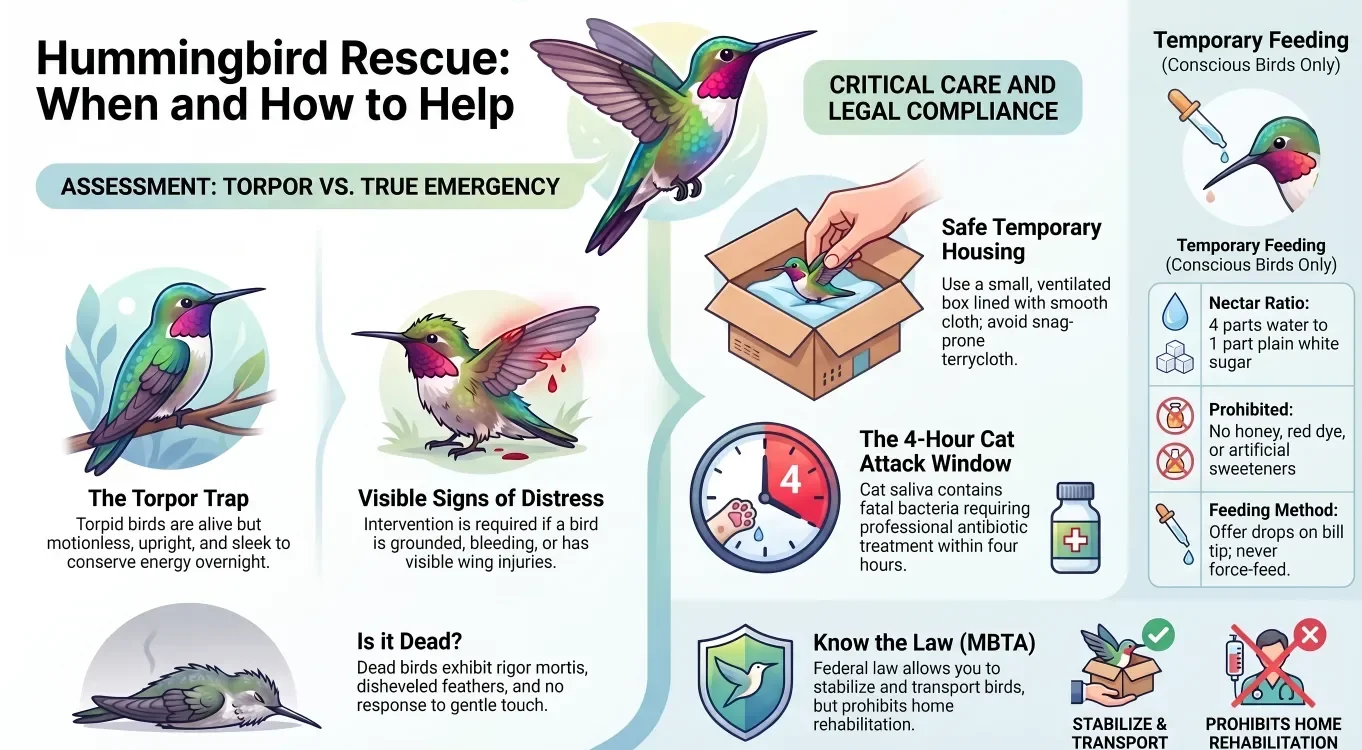
One of the most misunderstood situations in hummingbird rescue is finding a bird that appears dead but is actually in torpor. A hummingbird in deep torpor is motionless, unresponsive, cool to the touch, and may even hang upside down from its perch. Every year, people panic, attempt to warm or revive a bird, or rush it to a rehabilitator when it simply needs to be left alone to finish its natural overnight fast.
Signs a bird is in torpor rather than dead: it holds an upright or near-upright posture; its feathers are smooth and sleeked rather than fluffed; its feet grip the perch firmly, thanks to a tendon-locking mechanism in the legs; the body feels slightly warm; there may be a subtle response to gentle touch, such as a small tail or wing adjustment; and it is found in early morning or at dusk, the natural windows for entering and leaving torpor.
Signs a bird has died: the body is stiff with rigor mortis; feathers are fluffed, disheveled or blood-matted; posture is flat or at an odd angle; a mirror held gently near the beak shows no breath condensation; there is no response whatsoever to careful stimulation.
If you are unsure, move the bird to a warm, quiet, enclosed space away from drafts and predators. Place a small dish of nectar nearby. Do not handle it further. Wait up to one hour. A torpid bird will gradually show arousal: faster breathing, a body shake, twitching, and eventually flight. If nothing after an hour, contact a licensed rehabilitator.
The Four Most Common Emergencies
1. Window Collision
Window collisions are the most frequent cause of hummingbird injury around houses. The bird is typically stunned rather than killed outright, and many recover fully given time and quiet.
What to do: do not rush to pick the bird up. Watch from a distance for up to a minute. If it revives and attempts to fly, let it go.
If it is still motionless after that minute, gently scoop it up with smooth hands held close to the ground in case it suddenly recovers and drops. Line a small box with a smooth cloth such as a dishtowel. Do not use terrycloth, as the looping fibres tangle a bird’s claws and cause serious injury. Place the bird on the cloth, close the lid loosely for ventilation, and set the box somewhere quiet, warm and dark indoors.
Do not offer food or water at this stage. A concussed bird cannot swallow safely and force-feeding risks fatal aspiration. After 15 to 30 minutes, take the closed box outside, open it gently and step back. If the bird is ready, it will fly. If it has not flown after another 30 minutes, contact a rehabilitator.
Birds that appear to recover from a collision may still have internal injuries that surface hours later. If in any doubt after release, keep the rehabilitator’s number to hand.
2. Cat or Dog Attack
This is the most time-critical hummingbird emergency, and it is important to understand why even a visually unharmed bird is in serious danger.
The danger is bacterial rather than mechanical. More than 90 percent of cats carry Pasteurella multocida in their saliva and on their claws, which they lick regularly. The bacteria enter the bloodstream through even the smallest puncture and cause septicaemia, typically killing within 12 to 48 hours. A bird that appears completely unscathed still requires veterinary assessment and antibiotics. Among cat-caught birds that reach rescue alive, roughly 60 percent die of the infection rather than of the bite itself.
Cat teeth are thin and needle-like, so they can drive bacteria deep into muscle without leaving a mark visible through feathers. This is why rehabilitators ask whether a cat was involved before almost any other intake question: the answer changes the entire treatment plan.
What to do: contain the bird in a small ventilated box as described above and contact a rehabilitator or avian veterinarian the same day. Tell them it was a cat attack and say how long ago it happened. Do not wait to see whether the bird recovers. The sooner antibiotics start, the better the odds, and a bird can look entirely well in the morning and be dead by evening.
If you own an outdoor cat that catches hummingbirds, remove your feeders or keep the cat indoors. A feeder within reach of an outdoor cat causes harm rather than providing help, as our articles on hummingbird predators and the threats hummingbirds face both explain.
3. Trapped Indoors
A hummingbird that flies into an enclosed space will almost always head upward toward the highest point or toward light, which makes conventional rescue attempts useless. Opening doors and windows at ground level does not help, because the bird instinctively flies up and never registers that the exit is below.
What to do: first, keep everyone out of the space. Fewer people means less panic and fewer obstacles. Close all windows and doors and make the space as dark as possible by covering windows. Hummingbirds have poor night vision and will descend when they cannot see. Use a flashlight to locate the bird once it settles, then with slow, steady movements gently cup it in both hands and release it outside.
Alternatively, in a garage or barn, place a feeder on a long pole and move it slowly toward an open door. The bird may follow it out.
A bird trapped for more than two hours and found exhausted on the ground should be treated as an emergency.
4. Grounded Bird Without Obvious Cause
A hummingbird found on the ground in the open is in serious trouble. Their feet are not built for ground movement and their size makes them extremely vulnerable to predators. Do not assume it is resting.
Approach carefully, contain it as described, and start contacting a rehabilitator. While waiting, you may gently place a few drops of sugar water, four parts water to one part plain white sugar, on the very tip of the bill using an eyedropper or fingertip, letting the bird take it voluntarily. Do not force the bill open. If it takes the nectar willingly, offer more every 30 minutes. If it is unresponsive, do not attempt to feed it; focus on getting professional help fast.
Situations That Always Require a Rehabilitator
Regardless of how things appear, contact a licensed wildlife rehabilitator immediately if a hummingbird has been in a cat’s or dog’s mouth, even with no visible injury; has parasites such as mites or ants on its body; is bleeding, however slightly; has a wing that does not work normally, cannot close its bill, has a broken or crooked beak, cannot perch, or has visible sores; has been trapped for two hours or more and is found exhausted; cannot fly after time to recover; has struck a window and remains stunned beyond a minute; is a nestling with no parent seen after an hour of uninterrupted observation; is visibly struggling to breathe; or has any sticky, oily or adhesive substance on its feathers.
What NOT to Do: The Mistakes That Kill
Never force water or nectar into an unconscious or lethargic bird. A bird that cannot hold its head up cannot swallow. Force-feeding causes aspiration into the lungs, which is frequently fatal.
Never use honey. It ferments rapidly and causes fatal fungal infections. Plain white sugar dissolved in water at a 1:4 ratio is the only safe option, as covered in our nectar recipe and feeder guide.
Never add red dye. The feeder’s own red provides the visual attraction, and dye adds nothing while carrying unestablished risk. The diseases a badly managed feeder can cause are covered separately.
Never use a terrycloth container. The looping fibres catch claws and can cause fractures or dislocations as the bird struggles.
Never release a cat-attack bird without professional assessment. A bird flying normally may still be carrying fatal bacteria.
Never keep a hummingbird longer than necessary. Every minute of handling adds stress. Your role is temporary stabilisation and rapid transfer, not rehabilitation.
Never attempt to rehabilitate at home. Doing so without federal and state permits violates the Migratory Bird Treaty Act, regardless of intentions.
How to Find a Licensed Wildlife Rehabilitator
Saving these resources in your phone before an emergency happens can decide whether a bird survives.
Animal Help Now (ahnow.org) is the most practical real-time tool available. A free service with iPhone and Android apps, it uses your location to connect you with the nearest licensed rehabilitator, prioritising those open and available at that moment. In a time-critical situation, reach for this first.
The National Wildlife Rehabilitators Association maintains a directory of certified rehabilitators across the United States and Canada.
Your local veterinarian can often stabilise a hummingbird, administer antibiotics for a cat bite, and provide triage while a specialist is found, even without specific bird experience. Call ahead to confirm they will help.
Local humane societies and animal control usually keep current lists of local rehabilitators and can direct you quickly.
Temporary Care While Help Is on the Way
If professional help is not immediately available, your goal is stabilisation, not treatment.
The container: a small cardboard box with a lid, lined with a smooth cloth. Small enough that the bird cannot flutter and injure itself, but not so tight that airflow is restricted. Poke a few small air holes.
Temperature: warm but not hot. Ordinary room temperature suits most situations. Keep it away from heat vents, direct sunlight and cold surfaces.
Darkness and quiet: a dark, quiet environment reduces stress significantly. Keep children, pets and unnecessary people away.
Feeding, conscious birds only: if and only if the bird is alert and holding its head up, offer a few drops of plain sugar water at a 1:4 ratio on the tip of the bill. Let it take the liquid voluntarily. Never force the bill open. Repeat every 30 minutes if it accepts willingly.
Minimise handling: once the bird is in the container, close the lid and leave it. Repeated checking adds stress.
Baby Hummingbirds: Nestlings and Fallen Nests
Hummingbird nests are among the hardest to spot in nature. Only about two inches across, built from plant down bound with spider silk and camouflaged with lichen, they are typically saddled on a slender, often downward-sloping branch. The article on hummingbird breeding and nests covers how they are built and when.
Look for the nest above. Search carefully, and search from directly beneath, since the lichen camouflage is designed to defeat exactly the glance you are about to give it. If you find the nest and the nestling appears uninjured, gently replace it. Handle it as little as possible, but do not let the myth about human scent stop you: birds have a poor sense of smell and a mother will return to a handled nestling without hesitation.
If the nest itself has fallen, it can often be reattached to the branch with soft string or twist ties, as close to its original position as possible. Then monitor from a distance for at least an hour without looking away. A female’s feeding visits are brief and easy to miss. If the mother does not return, or is confirmed dead, contact a rehabilitator immediately. Nestlings have a very narrow survival window without specialist feeding: they need nectar for energy and the protein that comes from tiny insects and spiders, delivered several times an hour.
If no nest can be found, place the nestling in a small cloth-lined container, keep it warm, and contact a rehabilitator right away. Do not attempt to feed a nestling without professional guidance.
The Legal Framework
Understanding the law before you act protects both you and the bird.
The Migratory Bird Treaty Act of 1918 makes it illegal to capture, possess, hold, transport or sell any migratory bird, including hummingbirds, without a federal permit. This applies to birds you find injured. There is no good-Samaritan exemption for unlicensed individuals who keep injured birds at home.
What you legally can do: pick up an injured bird, place it in a temporary container, and transport it to a licensed rehabilitator or veterinarian. The law’s intent is to get injured birds into professional hands quickly, not to prevent compassionate short-term action during transport.
What you legally cannot do: keep the bird at home for rehabilitation, however briefly; attempt to treat it yourself; possess any part of a hummingbird, including feathers or nests; or release a bird held beyond the immediate emergency without a rehabilitator’s sign-off.
Violations carry fines of up to $15,000 and up to six months’ imprisonment for misdemeanours, with substantially higher penalties for commercial offences. Licensed rehabilitators hold both federal permits, issued by the U.S. Fish and Wildlife Service, and state-level permits. The article on hummingbirds and the law covers the protections in more detail.
Prevention: Reducing the Risk Before It Happens
Many hummingbird emergencies are preventable with a few straightforward changes.
Windows. Apply UV-reflective decals, external netting, or collision-deterrent film. A single decal on a large window achieves very little. The deterrent must cover most of the glass, with gaps between markings too narrow for a bird to attempt to fly through.
Feeder placement. Position feeders either within about three feet of a window, close enough that a collision cannot build up dangerous speed, or more than thirty feet away, far enough that birds are not approaching glass at speed. The middle distance is the danger zone. Feeders attached directly to window glass are particularly hazardous if a dominant bird drives a subordinate toward the window during a chase. The full reasoning is in the article on what kills hummingbirds.
Cats. If you keep an outdoor cat, remove or relocate your feeders. A hummingbird that visits regularly is a predictable target for a cat that has learned to wait below. The safest solution for the birds and for the cat is keeping the cat indoors.
Feeder hygiene. A dirty feeder can make a hummingbird sick enough to become grounded and vulnerable. Clean feeders and change nectar on a schedule set by temperature, more often in hot weather.
Spider webs. Hummingbirds gather spider silk for their nests and are occasionally caught doing it, most often in the large orb webs that appear in late summer. A bird that has been hanging for hours may be dehydrated, in shock, or injured, so do not simply pull it free. Cover its head with a small smooth cloth first, which calms it considerably. Then work the strands off with your fingers or blunt-tipped scissors, moving away from the body rather than pulling at it, and paying particular attention to the wing joints and feet where silk wraps tightest. Once free, put the bird in a box for fifteen minutes and watch it before release. A bird that cannot fly, or that was tangled long enough to be limp, needs a rehabilitator.
Note that this is not a reason to clear webs from your garden. Nesting females depend on that silk, and a garden that keeps its spiders is a better hummingbird garden. Tangling is rare; the silk is essential.
Frequently Asked Questions
I found an injured hummingbird. What should I do right now?
Contain it in a small ventilated box lined with smooth cloth. Keep it dark, warm and quiet. Contact a rehabilitator immediately, using Animal Help Now (ahnow.org) or your nearest licensed centre. Do not offer food unless the bird is conscious and alert, and do not attempt home rehabilitation.
A hummingbird hit my window and is not moving.
Place it in a dark, quiet, ventilated box with a smooth cloth liner, not terrycloth. Do not feed it. After 15 to 30 minutes, take the closed box outside, open it and step back. If it has not flown within another 30 minutes, contact a rehabilitator.
My cat attacked a hummingbird. Is it going to be okay?
Treat it as a medical emergency regardless of appearance. More than 90 percent of cats carry bacteria that cause septicaemia in birds, typically killing within 12 to 48 hours, and it can enter through a puncture you cannot see. Contact a rehabilitator or avian vet the same day and tell them a cat was involved.
Is my hummingbird dead or in torpor?
A torpid bird holds an upright posture with smooth feathers, a slightly warm body, and feet gripping the perch, and may respond faintly to touch. A dead bird is stiff, disheveled, shows no breath condensation on a mirror, and gives no response. If uncertain, move it somewhere warm and quiet and wait up to an hour.
I found a baby hummingbird on the ground.
Search for the nest above. If found, gently replace the nestling; touching it will not cause abandonment. If not, place it in a warm, cloth-lined container and contact a rehabilitator immediately. Nestlings need protein and nectar many times an hour and cannot survive without specialist care.
Is it illegal to keep an injured hummingbird?
Yes. The MBTA makes possession without a federal permit illegal, even for rehabilitation. You may contain and transport a bird to a licensed rehabilitator, but you may not keep it.
What is the correct sugar-water ratio for temporary care?
Four parts water to one part plain white sugar. Never honey, red dye or artificial sweeteners. Offer it only to a conscious, alert bird that can take it voluntarily from the tip of an eyedropper.
I found a hummingbird tangled in a spider web.
Cover its head with a smooth cloth to calm it, then work the strands off with fingers or blunt scissors, moving away from the body rather than pulling. Watch it in a box for fifteen minutes before release, and call a rehabilitator if it cannot fly.
Conclusion
The desire to help an injured hummingbird is one of the better impulses we act on. These birds have survived tens of millions of years of evolution to reach your garden, and they deserve every reasonable chance. The most important thing you can give them, in almost every situation, is speed: speed getting them to professional care, and the knowledge to avoid the well-meaning mistakes that cost them the time they do not have.
Quiz: Injured Hummingbird: What to Do
The quiz questions are grounded in wildlife rehabilitation guidance, veterinary sources and federal law, listed below:
A free service and smartphone app that uses your location to connect you with the nearest available licensed wildlife rehabilitator, prioritising helpers who are open at that moment. The first resource to reach for in any hummingbird emergency.
Emergency guidance from one of North America’s leading hummingbird field research programmes, covering container preparation, temporary feeding, transport, and the legal prohibition on keeping hummingbirds without a permit.
Authoritative rescue guidance including safe containment in a ventilated box, why the bird must reach a rehabilitator quickly given its metabolism, and the illegality of possession under the Migratory Bird Treaty Act.
Rehabilitation reference on cat-inflicted injuries, noting that they produce deadly septicaemia from Pasteurella multocida within 12 to 48 hours and that broad-spectrum antibiotics should be started immediately rather than after symptoms appear.
Veterinary guideline on the bacterium itself, its prevalence in cat mouths, how rapidly local infection establishes after inoculation, and the antibiotic classes effective against it.
Clinical reference on the fungal infections that fermented sugar solutions can cause in birds, the reason honey must never be used in nectar.
The authoritative federal source on scope and permit requirements, establishing that possessing an injured hummingbird without a federal rehabilitation permit is a violation, and that licensed rehabilitators hold permits under 50 CFR 21.
Audubon’s guidance on the one-to-four sugar and water ratio, and the reasons for avoiding honey, red dye, brown sugar and artificial sweeteners in any nectar offered to a hummingbird.
Cornell’s guidance on collision prevention, including why markings must cover the glass with narrow gaps rather than sitting as a single decal, and how feeder distance affects impact speed.