
If there were an Olympic event for most improbable migration, hummingbirds would take gold, silver, and bronze. These tiny adventurers, weighing less than a nickel, embark on journeys that make human marathon runners look like couch potatoes. A bird of three or four grams, flying thousands of miles on a thimbleful of stored fat, navigating with millimetre precision back to a flower patch it visited the previous year.
The scale of what hummingbirds accomplish during migration is genuinely staggering. And the science behind it is even more astonishing than the numbers alone suggest.
Here is everything you need to know: which species go, where they travel, how they prepare, and what it means for backyard birders hoping to welcome them home.
Do All Hummingbirds Migrate?
The short answer is no, and not even close. Of the more than 360 species of hummingbirds in the world, the majority are tropical birds that never migrate at all. They live year-round in the rainforests, cloud forests, and highland meadows of Central and South America, where nectar is available in every season and long-distance flight is simply not part of their life history.
Among North American species, however, migration is common, partly because North America’s hummingbird-friendly seasons are limited. The birds arrive each spring to exploit an abundance of flowers and insects in temperate and boreal zones, then head south before winter cuts off their food supply.
The Great Pre-Migration Bulk-Up
Before embarking on their journeys, hummingbirds enter what can only be described as extreme preparation mode. Imagine training for a marathon not by running, but by eating your own body weight every day for several weeks, while still being able to fly.
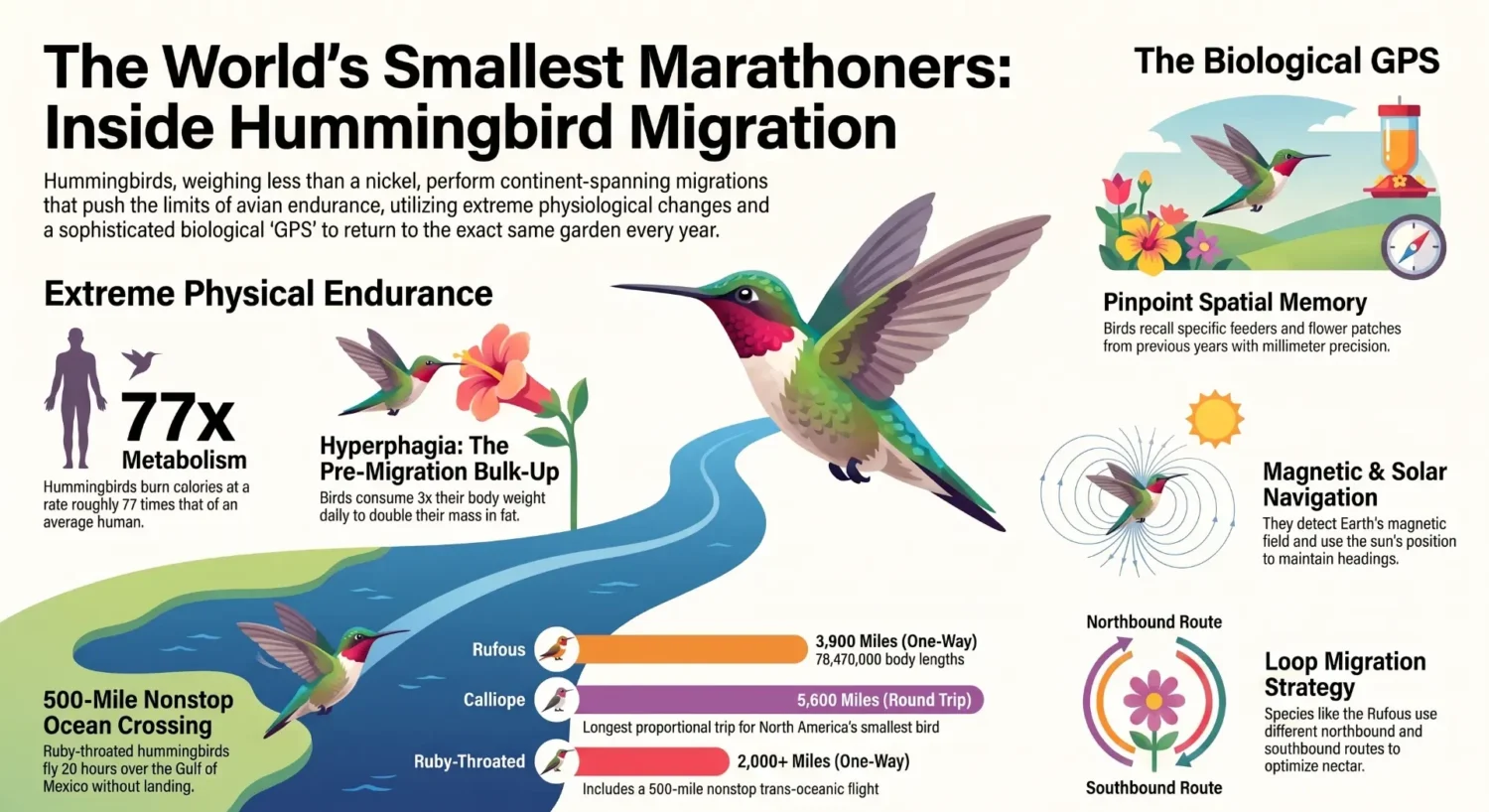
The process is called hyperphagia, a physiologically driven feeding frenzy in which a hummingbird feeds almost continuously, visiting hundreds of flowers in a single day’s foraging. The excess sugar is rapidly converted to fat stored in subcutaneous deposits across the body. Research published in the Nutrition Journal found hummingbirds accumulating over 40 percent body fat in the weeks before migration. A ruby-throated can go from roughly 3 grams to nearly 6, effectively becoming a tiny feathered butterball, with almost all of the extra mass being fuel-ready fat.
Our article on what hummingbirds eat covers the diet that makes this possible, including the insects that supply the protein nectar cannot.
Those reserves are the only energy source available during the long, nonstop stretches ahead. The demand is extraordinary: Johns Hopkins researchers sequencing the hummingbird liver genome describe a metabolism roughly 77 times faster than a human’s, sustained by hyper-efficient enzymes that handle blood sugar levels which would cause serious disease in people. Fat is the most energy-dense fuel available, and the bird metabolises it with remarkable efficiency during sustained flight.
One myth worth dispelling: leaving your backyard feeder up through autumn will not prevent hummingbirds from migrating. The decision to migrate is triggered by changes in day length, a hormonal response to the shortening photoperiod, not by food availability. A hummingbird whose biological clock has said it is time to go will not be delayed by a well-stocked feeder. It will simply have a slightly better-fuelled departure.
The Science of Navigation
Perhaps the most mind-boggling aspect of hummingbird migration is the navigation. Without GPS, maps, or even a tiny compass, these birds find their way across continents and back to the exact same gardens, feeders, and flower patches they visited the previous year.
Scientists have identified several mechanisms working in concert, though the full picture remains an active area of research.
Spatial memory is the most well-documented. Banding studies confirm that individual hummingbirds return to the same specific locations: the same feeders, the same flower patches, even the same perches across multiple years. The memory for spatial detail encoded in a brain smaller than a pea is, by any reasonable measure, extraordinary.
Magnetic sensitivity provides long-range directional orientation. Like many migratory birds, hummingbirds appear to detect the Earth’s magnetic field and use it as a compass, particularly during overcast conditions when the sun is not visible. Exactly how this works at the cellular level remains one of biology’s most intriguing open questions.
Solar position gives a reliable directional reference during clear-sky migration, integrated with the bird’s internal clock to maintain accurate headings across changing times of day.
Visual landmarks such as coastlines, mountain ranges, and river valleys likely inform navigation during the final approach to remembered feeding locations, along with the exceptional colour vision that lets them pick out nectar sources humans would miss entirely.
Juvenile hummingbirds migrate successfully in their first year without adult guidance, suggesting that the broad directional orientation is at least partly innate, with precision improving through experience in subsequent seasons.
The Rufous Hummingbird: The Distance Champion
If there is one hummingbird that belongs in every conversation about the limits of avian endurance, it is the Rufous Hummingbird (Selasphorus rufus).
At just over three inches long and weighing less than a nickel, it undertakes a one-way migration of approximately 3,900 miles from breeding grounds in Alaska and northwest Canada to wintering sites in Mexico. According to the Cornell Lab of Ornithology, that distance is equivalent to 78,470,000 body lengths, one of the longest migratory journeys of any bird in the world as measured by body size.
For context: the Arctic Tern is rightly celebrated for its annual pole-to-pole migration of over 11,000 miles. But at thirteen inches long, that journey amounts to 51,430,000 body lengths. The rufous, at a third the size, logs proportionally more distance.
The rufous breeds farther north than any other hummingbird species, regularly nesting in the Yukon and southeastern Alaska, where temperatures can drop below freezing during the breeding season. Males begin their southbound migration as early as late June, sometimes before the summer solstice. Oregon State University research published in Avian Conservation and Ecology documented that age and sex influence both timing and route, with males typically leaving earlier in autumn and females and juveniles following later through slightly different corridors.
Both legs pass through country covered by our regional guides: north up the Pacific Northwest coast in spring, south through the Rocky Mountains in late summer, with a growing number now wintering in the Southeast rather than Mexico.
The Ruby-Throated Hummingbird’s Gulf Crossing
The Ruby-throated Hummingbird (Archilochus colubris) is the only hummingbird species that regularly breeds east of the Mississippi, and each year it stages one of the most audacious individual feats in the animal kingdom.
Most ruby-throats migrate south along the Gulf Coast through Texas. But a significant number cross the Gulf of Mexico directly, a nonstop trans-oceanic flight of roughly 500 miles over open water, with nowhere to land and nothing to eat, typically lasting around 20 hours.
In a landmark 1962 study in The Condor, R.C. Lasiewski calculated that a male ruby-throated at 4.5 grams, of which 2 grams was stored fat from pre-migration hyperphagia, had just sufficient fuel to complete the crossing nonstop under favourable wind conditions. The margin was, to put it mildly, slim. Audubon has documented birds landing on boats mid-Gulf, and some have been found at the water’s surface after apparently exhausting their reserves within sight of the far shore.
Many ruby-throats travel more than 2,000 miles from wintering grounds in Panama to breeding destinations in Canada, a round trip exceeding 4,000 miles for the northernmost breeders, carried out twice a year. Their arrival across the Northeast and Midwest is one of the most closely watched events in North American birding.
The Calliope Hummingbird: Smallest Bird, Longest Round Trip
The calliope hummingbird (Selasphorus calliope) makes this list on sheer audacity. At approximately 3.1 inches long and 2.3 to 3.4 grams, it is the smallest bird native to North America. It also completes a round-trip migration of up to 5,600 miles, breeding in the mountain meadows of the northwestern United States and British Columbia before wintering in Mexico.
The calliope’s spring migration takes it north through the Rocky Mountains and Cascades, chasing the bloom of early mountain wildflowers. Its autumn route shifts east to follow late-blooming high-elevation corridors. Like the rufous, it uses a loop migration, different routes in each direction, to maximise exposure to fresh nectar sources both ways.
Weather Warriors
One of the more humbling aspects of hummingbird migration is what these birds routinely fly through. Thunderstorms, strong headwinds, temperature extremes, and rapidly shifting weather patterns are all features of the migratory environment.
When storms are unavoidable, hummingbirds lower their altitude to find calmer air near the ground. When headwinds are too strong to fight directly, they hug coastlines and ridgelines where terrain-deflected updrafts assist. When cold fronts arrive unexpectedly, as they frequently do during spring migration at northern latitudes, early-arriving males caught without sufficient nectar face genuine survival challenges. On a cold night with reserves low, torpor is the difference between morning and not.
What they do not do is turn back. A hummingbird that has cleared the coast and begun crossing the Gulf is committed. Whatever the weather brings, it brings.
Spring Migration: The Race North
Spring migration is a northbound race timed with remarkable precision to the flowering schedules of plants along the route. Hummingbirds do not simply follow warmth, they follow flowers, and flowers do not wait.
Ruby-throated hummingbirds begin arriving on the Gulf Coast in late February to early March, the wave moving steadily northward and reaching the Mid-Atlantic by mid-April, and New England and southeastern Canada by late April into May.
Males typically arrive at breeding territories a week to two weeks before females, staking out territories and establishing themselves at nectar sources before mate selection begins. The strategy carries real risk: an early male caught by a late cold snap before flowers are blooming is in genuine danger, but the territorial advantage makes the gamble worth taking.
Rufous hummingbirds begin their northbound movement along the Pacific Coast even earlier, with males moving through California as early as February, reaching Washington by late February to mid-March and Alaskan breeding grounds by late April or early May. Their route follows the coast, where early-blooming currants, gooseberries, and salmonberries provide critical refuelling stops at each latitude.
Autumn Migration: The Clockwise Circuit South
The rufous hummingbird’s autumn migration is one of ornithology’s most elegant navigation stories.
Rather than retracing its spring route, the rufous travels through the interior Rocky Mountains and Great Basin. This clockwise elliptical circuit, Pacific Coast north in spring and Rockies south in autumn, gives the birds access to a different sequence of late-summer wildflower blooms in alpine and subalpine meadows as they descend. They are, in effect, double-dipping on the continent’s nectar resources within a single annual cycle.
Adult males begin their autumn movement as early as late June, sometimes while females are still incubating eggs. Females and juveniles follow in July and August. By September, most rufous hummingbirds have crossed into the Desert Southwest, continuing toward Mexican wintering grounds.
Ruby-throated hummingbirds begin departing northern breeding grounds in August, with peak southward movement through the Gulf states in September. Most have crossed into Mexico and Central America by October.
Which Species Migrate, and Which Stay
Migratory North American species:
- Ruby-throated: breeds across eastern North America from the Gulf Coast to southern Canada; winters from Mexico to Panama. The only regular breeding hummingbird east of the Mississippi.
- Rufous: breeds from the Pacific Northwest to Alaska; winters in Mexico. The distance champion, and declining at approximately 2 percent annually, a genuine conservation concern.
- Calliope: breeds in northwestern mountain meadows; winters in Mexico. The smallest bird in North America, with the proportionally largest round trip of any hummingbird.
- Broad-tailed: breeds in Rocky Mountain meadows; winters in Mexico. Males produce a distinctive metallic wing trill from modified primary feathers, identifiable by ear alone.
- Black-chinned: breeds across western North America; winters along Mexico’s Pacific coast.
Year-round or largely non-migratory species:
- Anna’s: the most cold-tolerant North American hummingbird. Originally resident in coastal California and Baja, it has dramatically expanded its year-round range northward into Oregon, Washington, British Columbia, and even southeastern Alaska, partly fuelled by warming winters and the proliferation of winter-flowering garden plants and backyard feeders.
- Costa’s: largely resident in the deserts and coastal scrub of southern California and the Southwest, breeding very early and moving seasonally rather than migrating far.
- Buff-bellied: year-round resident of southern Texas, with some post-breeding dispersal northward along the Gulf Coast.
- Broad-billed: largely year-round in southern Arizona and New Mexico, with partial seasonal movement.
Feeders and Migration
Two rules cover almost everything. Put feeders out one to two weeks before hummingbirds are expected in your area, so an arriving migrant finds a stocked feeder and establishes it as a reliable stop. Leave them up two to three weeks after your last sighting in autumn, which helps late migrants and cannot delay anyone.
Because arrival dates differ by nearly three months between the Gulf Coast and northern Maine, the region-by-region detail lives in our guide to when to put feeders out and take them down. Where Anna’s hummingbirds winter, feeders can stay up all year.
The Conservation Challenge
The modern world presents genuine challenges to migration patterns that evolved over millions of years, and hummingbirds are not immune.
Habitat loss along established routes reduces the density of natural nectar sources that migrants depend on. The nectar corridor of blooming wildflowers that guides rufous hummingbirds through the Rockies each autumn is increasingly fragmented by development, agricultural conversion, and invasive plants.
Climate change is shifting the timing of flower blooms independently of the hormonal cues that trigger migration, creating mismatches between when birds arrive and when their food is available. A hummingbird that arrives on schedule to find its expected flowers two weeks from blooming has a serious energy problem.
Urban development fragments movement corridors and introduces structures, particularly windows, that cause direct mortality during migration.
Pesticide use depletes the insect populations that provide migrants with essential protein alongside nectar.
All of these, and what you can do about the ones in your own yard, are covered in our article on the threats hummingbirds face. The single most useful contribution most people can make is a garden with staggered bloom across the season, which turns a yard into one link in a functioning corridor.
The rufous hummingbird’s documented decline of approximately 2 percent annually is a concerning signal. Citizen science programmes, particularly eBird and the Hummingbird Monitoring Network, provide the range-wide data needed to track population trends and identify which parts of the route are under most pressure.
Frequently Asked Questions
Do hummingbirds migrate?
Most of the world’s 360-plus species are tropical and do not. Among North American species, several do, including the ruby-throated, rufous, calliope, broad-tailed, and black-chinned. The Anna’s is a notable year-round resident that has expanded its range northward into the Pacific Northwest.
Which hummingbird has the longest migration?
The rufous, at approximately 3,900 miles one-way from Alaska to Mexico. Measured in body lengths, 78,470,000, which exceeds even the Arctic Tern’s famous journey by that measure.
Do hummingbirds fly across the Gulf of Mexico?
Yes, some ruby-throats cross nonstop, roughly 500 miles over open water, in a flight lasting around 20 hours, fuelled by fat stored during pre-migration hyperphagia.
When do hummingbirds migrate north in spring?
Ruby-throats reach the Gulf Coast in late February to early March and arrive in New England by late April or May. Rufous begin moving north along the Pacific Coast as early as February, reaching Alaska by late April.
Will leaving my feeder up prevent hummingbirds from migrating?
No, Migration is triggered by changes in day length, not food availability. Leaving feeders up will not delay a bird whose biological clock has said it is time to leave, though it may attract late stragglers or winter vagrants.
Do hummingbirds return to the same place each year?
Yes, Banding studies confirm that individuals return to the same gardens, feeders, and flower patches year after year. If a hummingbird found your feeder last summer, there is a meaningful chance the same bird will return next spring.
What is the rufous hummingbird’s migration route?
A clockwise elliptical circuit: northbound along the Pacific Coast in spring, southbound through the interior Rockies in late summer and autumn, giving access to two different bloom sequences in a single year.
Conclusion
The next time a ruby-throated hummingbird appears at your April feeder, just off a 500-mile nonstop flight across the Gulf of Mexico, or a rufous drops into your garden on its way south from Alaska, take a moment. You are watching one of the most improbable athletes in the natural world refuel at a pit stop on a journey that makes our own travel look modest by comparison. Gold, silver, and bronze, every year, without exception.
Quiz: Hummingbird Migration
The quiz questions are grounded in peer-reviewed research, ornithological field studies, and authoritative science sources listed below:
Primary source for the 3,900-mile one-way migration, the 78,470,000 body-length figure against the Arctic Tern’s 51,430,000, and the clockwise circuit of western North America.
The source for the metabolic comparison. Johns Hopkins researchers, sequencing the hummingbird liver genome as part of an international collaboration, describe a metabolism 77 times faster than a human’s, made possible by hyper-efficient enzymes that process blood sugar levels which would cause serious disease in people.
Peer-reviewed account of migratory fat loading. Documents that hummingbirds accumulate over 40 percent body fat shortly before migration, that the 3 to 4 gram Ruby-throated has among the highest mass-specific metabolic rates known, and that it loses most of its stored fat during roughly 20 hours of Gulf crossing.
The foundational study calculating that a 4.5-gram male ruby-throated hummingbird carrying 2 grams of fat had just sufficient reserves to complete the Gulf crossing under favourable winds.
The research release behind the Avian Conservation and Ecology paper, documenting the roughly 2 percent annual population decline and the differing timing and routes used by birds of different ages and sexes.
Independent confirmation of the body-length comparison, the clockwise loop up the Pacific Coast and back down the Rockies, and the species’ Near Threatened status.
Documents the calliope as the smallest bird native to North America and its round-trip migration of up to 5,600 miles between northwestern breeding grounds and Mexican wintering areas.
Establishes that leaving feeders up does not delay migration, and documents the western hummingbirds that now winter in the southeastern United States.
Species-by-species migration patterns, the body-length comparison with the Arctic Tern, and the Anna’s Hummingbird’s year-round range expansion into the Pacific Northwest.