At first glance a hummingbird looks like a very small bird. Look closer and almost nothing about it works the way it does in other birds. It generates lift on a stroke other birds waste. It flies backward on purpose. It runs a metabolism so fast that it would starve overnight without shutting its body down. Nearly every system it has is pushed to an extreme. It is the combination of those extremes, rather than any single one, that makes a hummingbird unlike anything else with feathers.
Here is what genuinely sets them apart.
A Family Apart
Hummingbirds belong to the order Apodiformes, which they share with the swifts. The name means “without feet,” a reference to their tiny legs, which are built for gripping a perch rather than walking. Within that order they form their own family, Trochilidae, with more than 360 species, the vast majority in Central and South America. Only a handful reach North America, and the species you are most likely to see are covered separately.
The size range within the family is enormous for birds this small. The Bee Hummingbird of Cuba, about 6 centimetres long and around 2 grams, is the smallest bird on Earth. It is also among the smallest warm-blooded animals of any kind, rivalled by mass only by a few shrews and bats. At the other end are the giant hummingbirds of the Andes, weighing 17 to 31 grams, almost twice the weight of any hummingbird outside their own genus. Until 2024 these were treated as a single species; genomic work has since shown they are two, a Northern and a Southern Giant Hummingbird that look almost identical. The two extremes make a revealing comparison of their own.
The Fastest Metabolism of Any Bird
Everything about a hummingbird follows from its engine. Johns Hopkins researchers, sequencing the hummingbird liver genome, describe a metabolism roughly 77 times faster than a human’s. It is sustained by hyper-efficient enzymes that handle blood sugar levels which would cause serious disease in people.
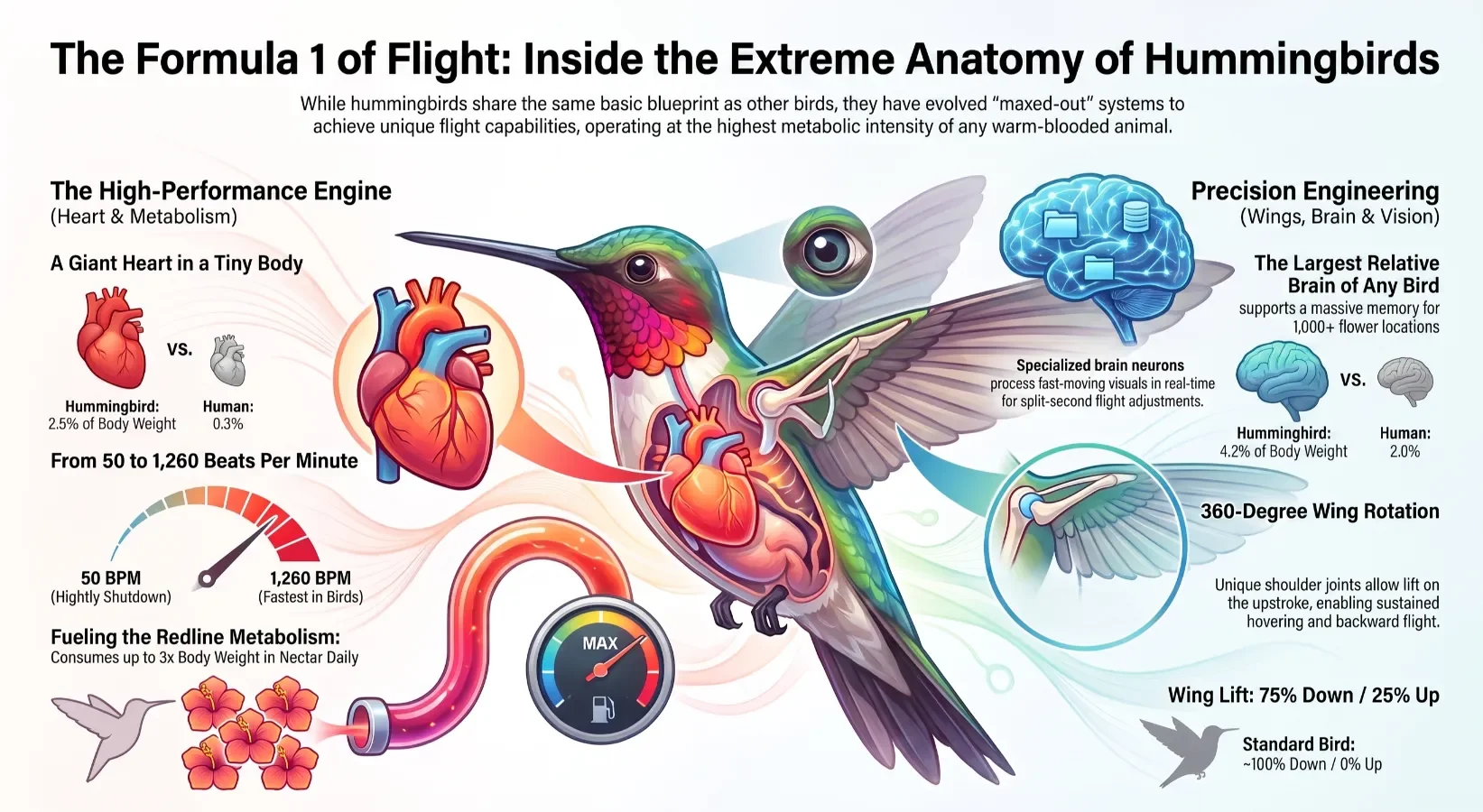
The heart that supports it has been recorded at up to about 1,260 beats a minute, the highest rate measured in any bird. A hummingbird can also burn sugar it swallowed only minutes earlier to power the flight muscles that carried it to the flower. The fuel for all of this, including the insects that supply what nectar cannot, is covered in our article on what hummingbirds eat.
The cost of running that hot is that there is almost no reserve. A hummingbird is rarely more than a few hours from starvation. That is why it feeds many times an hour through the day, and why at night it has to do something no songbird needs to.
Flight That Breaks the Rules
Most birds generate essentially all their lift on the downstroke and use the upstroke to reset the wing. Hummingbirds do not. Research published in Nature in 2005 found they produce about 75 percent of their hovering lift on the downstroke and 25 percent on the upstroke. That places them between insects, which split roughly evenly, and every other bird.
The upstroke lift comes from a shoulder joint with exceptional rotational freedom. As the wing sweeps back, it flips partially upside down, changing its angle to the air so that it pushes the bird up rather than down. No other bird inverts its wing this way. Powering it takes an unusually configured engine. Flight muscle makes up roughly 25 to 30 percent of a hummingbird’s body mass, against around 15 to 18 percent for the breast muscles of most birds. Some strong fliers, however, come close to the hummingbird figure. What is genuinely unique is the division of that muscle. The upstroke muscle is about half the size of the downstroke muscle, where in most birds it is closer to a fifth. That is the engine behind the upstroke lift.
Wingbeat frequency varies with size, from about 12 to 15 beats a second in the Giant Hummingbird to around 80 in the Bee Hummingbird during normal hovering. The full aerodynamics, including why hovering is the most expensive thing a hummingbird does, are explained in detail separately.
The Only Birds That Fly Backward, Properly
Other birds can manage an awkward backward flap for a wingbeat or two. Hummingbirds are the only birds capable of sustained, efficient backward flight, and they use it routinely to back away from flowers.
The surprise is the cost. Research on Anna’s Hummingbirds found backward flight costs roughly 20 percent less energy than hovering, with a power profile closer to forward flight. It is not an emergency manoeuvre. It is simply one of the ways a hummingbird moves.
Speed Measured Against Size
In level flight most hummingbirds cruise at 25 to 30 miles an hour, respectable but unremarkable. The record that stands out comes from the courtship dive. This is a display in which a male climbs high above a female, then plunges steeply past her and pulls up sharply at the bottom. The male Anna’s Hummingbird reaches about 385 body lengths per second in this dive, the highest length-specific velocity recorded in any vertebrate. Pulling out of it subjects the bird to close to nine times the force of gravity; human fighter pilots typically black out around seven without a pressure suit.
The dive is part of an elaborate courtship display. The explosive chirp at the bottom of it comes not from the voice but from the tail feathers, one of several sounds hummingbirds make with their bodies.
Near-Hibernation, Every Night
A songbird can doze through the night on the fat it built during the day. A hummingbird cannot. Its metabolism would burn through its reserves before dawn, so it does something much more drastic: it enters torpor.
In torpor, heart rate falls from over a thousand beats a minute to around 50, breathing becomes almost imperceptible, and body temperature drops dramatically. The lowest body temperature ever recorded in any bird or non-hibernating mammal, 3.26 degrees Celsius, was measured in a torpid black metaltail hummingbird in the Peruvian Andes. Even so, a hummingbird can lose as much as 15 percent of its body weight overnight.
The physiology of torpor has its own article, and so does where and how hummingbirds sleep, including the grip mechanism that keeps a torpid bird from falling off its perch.
A Brain Built for Memory
Hummingbird brains are about 4.2 percent of body weight, the highest raw proportion of any bird. That figure is real, but it is less remarkable than it sounds. Across animals generally, smaller species have proportionally larger brains than their larger relatives, a pattern known as Haller’s Rule. Once body size is taken into account, hummingbirds fall within the normal range for related bird groups. The large ratio mostly reflects how small they are.
What is genuinely exceptional is one particular structure. The hippocampus is the brain region associated with spatial memory. A 2012 study in Biology Letters found it two to five times larger in hummingbirds than in songbirds, seabirds and woodpeckers, measured relative to the rest of the forebrain. The forebrain is the front and largest part of the brain, where learning, memory and complex behaviour are handled. Because that comparison is made within the brain rather than against the body, it is not a side effect of size. It is a real specialisation.
It also matches what the birds do. A hummingbird has to track the location of many flowers across its territory, which ones it has already emptied, and how long each takes to refill. Field and laboratory work has shown they do exactly that. The same spatial memory brings individuals back to the same gardens across thousands of miles of migration year after year.
Seeing Colours We Cannot
Humans have three types of colour-sensing cone. Hummingbirds have four, including one sensitive to ultraviolet, and each cone contains a pigmented oil droplet that sharpens colour discrimination further.
The consequence is not just that they see ultraviolet. They perceive combinations such as UV+green and UV+red as distinct colours, hues that no human has ever seen. A 2020 study showed wild hummingbirds reliably telling apart two colours that looked identical to the researchers running the experiment. What hummingbirds actually see is one of the most striking findings on this site.
Learning to Sing
Most birds are born knowing their calls. Hummingbirds are among the few that learn them. Vocal production learning has evolved independently in only three groups of birds: songbirds, parrots and hummingbirds, none of them closely related. Tellingly, the hummingbirds’ nearest relatives, the swifts, do not learn their calls at all.
A Tongue That Works Like a Pump
The hummingbird tongue was assumed for 180 years to draw nectar up by capillary action. High-speed filming overturned that. The bill squeezes the forked tongue flat on the way out, and the grooves spring back when they touch nectar, filling like a tiny elastic pump. How hummingbird tongues actually work covers this in slightly more detail.
Feet Built for Holding On
Those tiny feet are the source of the order’s name, and they do one job well. Hummingbirds rarely walk; they shuffle sideways along a branch and fly even very short distances. But the feet grip superbly. When a perched bird’s legs bend under its own weight, the tendons tighten and the toes lock around the branch with no muscular effort. That is what allows a hummingbird to spend the night in deep torpor without falling.
Colour Without Pigment
The brilliant flash of a male’s throat is not paint. It is structural colour, produced by stacked nanostructures in the feather barbules that interfere with light. A feather’s central shaft carries side branches called barbs, and barbules are the microscopic branches growing off those, hooking together to form the feather’s surface. That is why a gorget can blaze red one moment and look black the next as the angle changes. How that colour is made, and why it matters in courtship, is its own story.
Frequently Asked Questions
What makes hummingbirds different from other birds?
A combination of extremes rather than any single trait. They include the fastest metabolism of any bird, lift on the upstroke, sustained backward flight and nightly torpor. Hummingbirds also have an enlarged hippocampus for spatial memory, learn their songs, and see ultraviolet colour.
Are hummingbirds the only birds that can fly backward?
They are the only birds capable of sustained, efficient backward flight. Other birds can manage a brief reverse, but hummingbirds use it routinely, and it costs them less energy than hovering.
Do hummingbirds have the biggest brains of any bird?
As a raw proportion of body weight, about 4.2 percent, yes. But that is largely because they are small; smaller animals generally have proportionally larger brains. Adjusted for size they are typical. What is genuinely enlarged is the hippocampus, the region for spatial memory, which is two to five times larger than in other birds relative to the rest of the brain.
How fast does a hummingbird’s heart beat?
Around 250 beats a minute at rest and over a thousand when active. The highest rate ever recorded, about 1,260 a minute, was measured in a Blue-throated Mountain-gem, the fastest measured in any bird. In torpor it can fall to around 50.
Why can’t hummingbirds walk?
Their feet are tiny and built for gripping rather than walking. They shuffle sideways along a perch and fly even short distances.
How many colours can hummingbirds see?
More than we can. With four cone types including an ultraviolet one, they perceive colour combinations such as UV+green that no human has ever seen.
What order do hummingbirds belong to?
Apodiformes, which they share with the swifts. The name means “without feet.”
Conclusion
A hummingbird is not a small version of an ordinary bird. It is a separate solution to the problem of being a bird, one in which almost every system has been pushed to a limit. Its heart races past a thousand beats a minute, and its wings lift on both strokes. Its body nearly shuts down every night, and part of its brain is built to remember every flower worth returning to. Any one of those would be remarkable. All of them together, in an animal that weighs less than a nickel, is what makes a hummingbird unlike anything else in the air.
Quiz: How Are Hummingbirds Different From Other Birds?
The quiz questions are grounded in peer-reviewed research and authoritative sources listed below:
Found the hippocampal formation significantly larger, relative to telencephalic volume, than in any bird examined to date: two to five times larger than in caching and non-caching songbirds, seabirds and woodpeckers. Because the comparison is against the rest of the brain rather than the body, this is a genuine specialisation rather than a side effect of small size.
The corrective on brain size. Hummingbirds have exceptionally large brains as a raw proportion of body weight, but this is almost exclusively an effect of negative allometry, since smaller birds are expected to have proportionally larger brains. Corrected for body size, hummingbirds fall comfortably within the range of other early-diverging bird groups.
Explains Haller’s Rule, the widespread pattern by which small species have relatively larger brains and eyes than larger relatives, and the skull adaptations hummingbirds use to house them.
Showed hummingbirds generate about 75 percent of hovering lift on the downstroke and 25 percent on the upstroke, placing them between insects and all other birds.
Found sustained backward flight costs about 20 percent less than hovering, with a power curve closer to forward flight.
Showed that the Giant Hummingbird is two species, a migratory southern form and a resident high-Andean northern form that diverged roughly two to three million years ago. Also the source for the 17 to 31 gram mass range, almost twice that of any hummingbird outside the genus Patagona.
Source for the metabolism figure: roughly 77 times faster than a human’s, sustained by hyper-efficient enzymes handling blood sugar levels that would cause disease in people.
Documents torpor heart rates falling to around 40 to 50 beats per minute and a record body temperature of 3.26 degrees Celsius in a black metaltail.
Demonstrated that hummingbirds’ four cone types let them perceive colours such as UV+green and UV+red that humans cannot see.