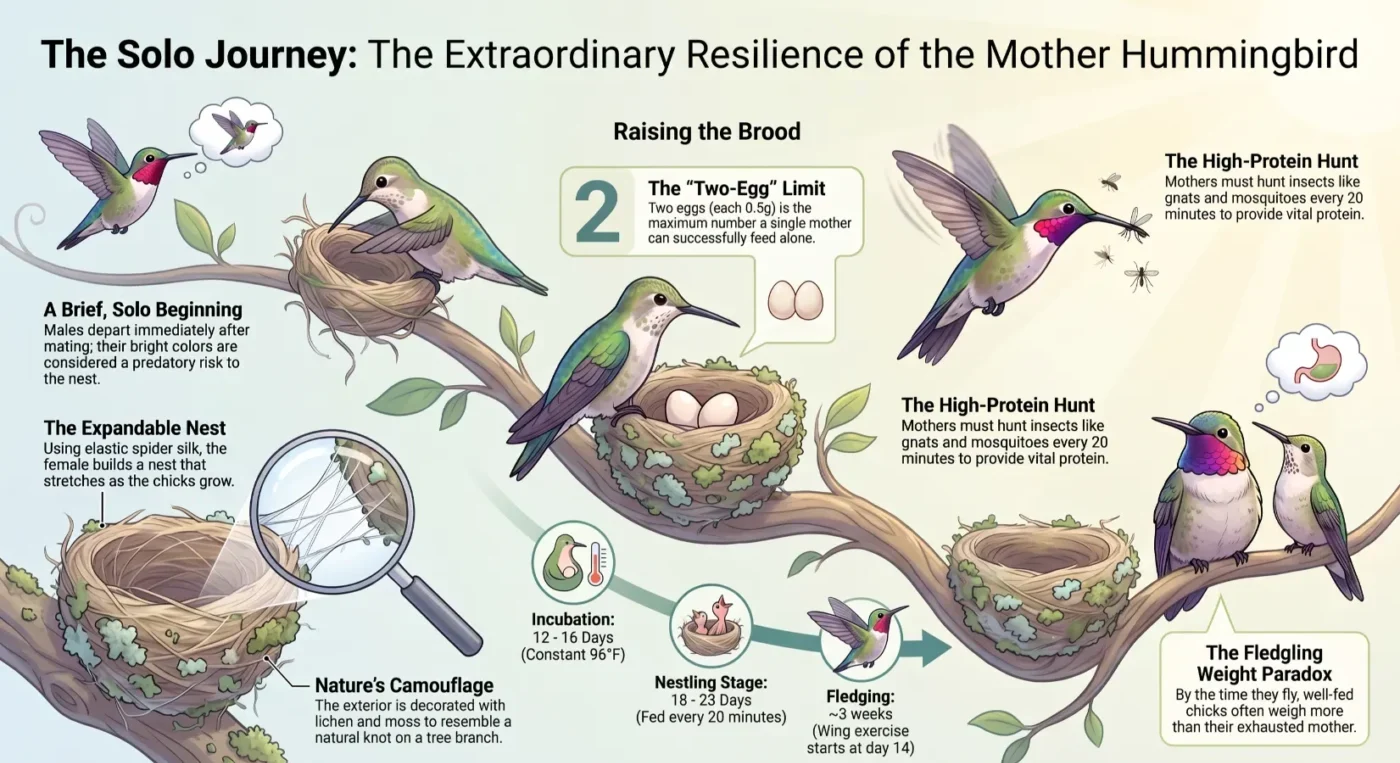

In the world of avian reproduction, hummingbirds have evolved one of the most distinctive strategies in the entire bird kingdom. There is no pair bond, no shared parenting, no nest built by two. Instead, the male’s entire contribution ends moments after mating, and the female builds, incubates, feeds, and defends completely alone. She is one of nature’s most capable single parents, raising a new generation of aerial acrobats from eggs the size of coffee beans, in a nest smaller than a walnut shell.
Here is how hummingbird breeding actually works, from the courtship display through to the moment the young birds fly.
The Hummingbird Mating System: Brief and Businesslike
Biologists call this arrangement promiscuous, or polygynous. A single male will mate with as many females as he can attract to his territory over the course of a season, and a female may visit several males before choosing one. Neither sex is monogamous, and hummingbirds do not mate for life.
The interaction itself is remarkably brief. There is no courtship feeding, no shared nest-building, and no ongoing bond of the kind seen in many other birds. Once mating has taken place, the female departs to build her nest, and the male returns to displaying for the next female that enters his territory.
This is one of the most distinctive strategies among birds, since a significant majority of species form at least seasonal pair bonds and share parenting duties to some degree. Hummingbirds abandoned that model completely, and the reasons for it turn out to be rooted in the same extreme energy economics that shape every other aspect of their biology.
The Courtship Display: How Males Compete for Females
Before any mating happens, the male has to earn it.
Males arrive on the breeding grounds in spring, typically a week to two weeks ahead of the females, and immediately establish and aggressively defend territories centred on good nectar sources. When the females arrive, the males switch into display mode. The signature performance is the dive display: the male climbs from as high as 12 to 15 metres above her, then plunges toward the ground at tremendous speed, pulling up sharply at the last moment to trace a dramatic U-shaped arc. In many species, the dive is accompanied by loud sounds produced by the wings and tail feathers, and by vocal chittering. At close range, he switches to a shuttle display, a rapid back-and-forth flight performed just in front of her, timed so his iridescent throat feathers flash at her eye level. The mechanics of that colour flash, and why a male can effectively switch it on and off, are covered in the article on hummingbird colour and courtship.
The female watches, evaluates, and chooses. She may assess several males before settling, weighing display quality alongside the richness of each male’s feeding territory. The choice is entirely hers, which places significant evolutionary pressure on males to display as impressively as possible.
Why the Male Leaves: The Logic of Single Parenting
It can seem harsh that the male contributes nothing beyond mating, but there is a clear evolutionary logic to it, and it comes down to two factors.
The first is energy economics. Hummingbirds live at the absolute edge of what a warm-blooded metabolism can sustain. A male that stayed to help raise young would be one more high-energy body to feed from the same territory, competing with the female and chicks for the very nectar they need. By leaving, the male reduces the feeding pressure on the nest site.
The second factor is camouflage. This is the more surprising reason. The male’s brilliant iridescent plumage, so useful for attracting females, is a serious liability near a nest. Those flashing colours would draw the attention of predators directly to the location of the eggs and chicks. Some biologists suggest the female actively keeps the male at a distance for exactly this reason: his conspicuous colouring is a threat to the nest’s survival. The female’s own plumage, by contrast, is subdued and green, allowing her to come and go from the nest without giving away its position.
By mating with multiple females and investing nothing further, a successful male can father far more offspring than he could by helping raise a single brood. And by handling everything herself in camouflaged secrecy, the female maximizes the survival odds of each nest. The arrangement is not romantic, but it is reproductively efficient for both parties.
The Nest: An Expandable Marvel of Spider Silk
The hummingbird nest is one of the most sophisticated small structures built by any animal, and the female constructs it entirely alone over roughly 6 to 10 days.
The nest of a ruby-throated hummingbird is tiny: about 2 inches across and 1 inch deep, with an inner cup roughly the size of a large thimble, and the whole structure comparable to half a walnut shell. It is usually built directly on top of a slender, often downward-sloping branch, typically 10 to 40 feet above the ground in a deciduous tree, positioned over an opening or stream where the female has a clear flight path in and out.
The construction is ingenious. The female binds together soft plant down, such as thistle and dandelion fluff, using strands of spider silk, and sometimes pine resin, as the binding agent. The spider silk is the key innovation: it is both strong and elastic. The female stamps on the base to stiffen it while deliberately leaving the walls pliable, so that the nest can stretch and expand as the chicks grow inside it. A nest that comfortably holds two eggs will gradually enlarge to accommodate two rapidly growing nestlings without needing to be rebuilt.
The exterior is then camouflaged with bits of lichen and moss, pressed and smoothed onto the outside, making the finished nest almost impossible to spot against the bark of the branch. The female shapes the rim by pressing and smoothing it between her neck and chest. The result is a structure that is expandable, camouflaged, insulated, and precisely sized, built without any assistance and using materials barely visible to the human eye.
The Eggs: Two Tiny White Jewels
A hummingbird clutch almost always contains exactly two eggs. Occasionally there is only one, and three is extremely rare. This consistency is not arbitrary: two appears to be the maximum number of chicks a single female can successfully feed alone. If she laid only one, she would not be maximizing her reproductive output; if she laid three, the likelihood is that she could not gather enough food for all of them, and the entire brood might starve. Two is the number that natural selection has settled on as optimal for a single parent.
The eggs are astonishingly small. A ruby-throated hummingbird egg measures about 13mm long and 8mm wide, weighs around half a gram, and is commonly compared to a coffee bean, a small jellybean, or a tic tac. They are pure white, unlike the speckled or colored eggs of many other birds, because a camouflaged nest means the eggs themselves do not need protective coloration.
The female typically lays the first egg, skips a day, and then lays the second. Crucially, she does not begin full incubation until both eggs are laid. This ensures the two chicks develop on the same schedule and hatch on the same day, rather than one emerging a day or two ahead of the other. It is a small but elegant piece of timing control that gives both chicks an equal start.
Incubation: The Female’s Solo Vigil
Incubation lasts approximately 12 to 16 days in the ruby-throated hummingbird, sometimes extending to 18 days or longer in cool weather, since lower temperatures slow the development of the embryos. The female does this entirely alone.
She keeps the eggs at a temperature of around 96°F (36°C), sitting tight on the nest and leaving only for a few minutes each hour to feed herself. This is a demanding balance. She must maintain her own extreme metabolism, which requires near-constant feeding, while also keeping the eggs consistently warm. Every foraging trip is a race against the eggs cooling. In cold or wet weather this balance becomes precarious, and a prolonged cold snap that forces her off the nest too long, or that kills the developing embryos outright, can end the nesting attempt entirely.
If the nest fails at this stage, whether from weather, a windstorm that blows it down, or predation, the female will often start over and build a new nest, provided enough of the breeding season remains. In the short breeding seasons of the northern United States and Canada, a female who loses a late nest may not have time to try again that year.
The Chicks: From Naked Hatchling to Fledgling
Hummingbird chicks hatch in an extremely undeveloped state, a condition biologists call altricial. A newly hatched ruby-throated hummingbird is roughly 2.5 cm (one inch) long, weighs approximately 0.62 grams (about a quarter the weight of a US dime), and enters the world blind, featherless, and utterly helpless, with only two thin rows of pale pinfeathers along its back.
The transformation over the following weeks is remarkable. The chicks’ eyes begin to open at around 7 to 9 days. Feathers develop progressively, and within about three weeks the full flight plumage has grown in. Throughout this period the expandable spider-silk nest stretches to accommodate the growing bodies. The female removes waste to keep the nest clean and sanitary, and continues to brood the chicks closely while they are small and unable to regulate their own body temperature.
Fledging, the point at which the young birds leave the nest, occurs approximately 18 to 23 days after hatching, though it can range from 14 to over 30 days depending heavily on how successfully the mother has been able to find food. Well-fed chicks develop faster. Interestingly, at the point of fledging the young are often heavier than their own mother, having been fed intensively while she has worn herself down feeding them. They begin exercising their wings in the nest at around two weeks old, building the muscle and coordination they will need before the first flight.
Feeding the Young: Nectar, Insects, and Constant Work
Feeding two rapidly growing chicks is one of the most demanding tasks in the natural world, and it reveals something many people do not know about hummingbird diet: chicks cannot be raised on nectar alone.
Growing hummingbirds need protein to build muscle, feathers, and body tissue, and nectar provides almost none. So the female spends much of her day hunting small soft-bodied insects and spiders: mosquitoes, gnats, fruit flies, small bees, aphids, caterpillars, and insect eggs. She combines these with nectar and returns to the nest to feed the chicks by regurgitation, inserting her long bill deep into each chick’s throat and pumping the partially digested mixture down with a distinctive up-and-down motion of her throat.
The pace is relentless. Small chicks need feeding roughly every 20 minutes throughout the day. When the female returns to the nest, the chicks feel the downdraft from her wings and instinctively lift their heads and open their mouths to be fed. As the chicks grow larger and hungrier, she must spend more and more of her time foraging, leaving the nest for longer periods to gather enough food. The energy cost to the female across the full nesting cycle is enormous, which is part of why she often emerges from a successful brood lighter and more worn than when she began.
This is also a good reason to welcome hummingbirds to a garden: a nesting female is an intensive consumer of exactly the small nuisance insects, including mosquitoes and gnats, that most people would rather do without.
Broods per Season: How Many Families in a Year
The number of broods a female raises in a single season depends heavily on geography, climate, and food availability.
In the warmer southern parts of the range, where the breeding season is long, a female ruby-throated hummingbird may raise two or even three broods in succession. In the shorter seasons of the northern United States and Canada, there is often only enough time to raise a single brood before the birds must prepare for autumn migration.
Remarkably, females sometimes overlap broods to make the most of a limited season. There are documented cases of a female beginning construction of a second nest, and even laying eggs in it, while she is still feeding chicks in her first nest. This overlapping strategy allows her to squeeze the maximum reproductive output from the available warm months. Females may also reuse the same nest for a second clutch, or rebuild on the same branch, and some return to the same tree in successive years.
If You Find a Nest in Your Garden
The best thing you can do with a hummingbird nest is leave it completely alone. The female is easily disturbed, the nest is far more fragile than it looks, and repeated approaches can cause her to abandon the site. Watch from a distance, hold off on pruning that branch until the season is over, and keep pets away from the area.
If a nest is blown down in a storm, or you find a chick that has genuinely fallen, the answer is rarely to intervene yourself. Nestlings need feeding every twenty minutes with a protein mixture that no household can improvise, and in most places it is illegal to keep one. Contact a licensed wildlife rehabilitator instead.
Conservation and Breeding Success
The picture for the most familiar North American species is better than for most hummingbirds, but it is not as simple as it first looks.
Over the long run the numbers are good. The North American Breeding Bird Survey recorded a steady increase in ruby-throated hummingbird populations from 1966 through 2019, Partners in Flight estimates a global breeding population of around 36 million, and the species is rated one of low conservation concern. Set against the steep declines seen in Rufous, Allen’s and Broad-tailed hummingbirds, that is a genuinely healthy position.
The recent trend is less reassuring. A 2021 analysis in Scientific Reports examining shorter-window survey data found that ruby-throated hummingbirds in eastern North America have been declining since roughly 2004 across most of the breeding range. A fifty-year increase and a twenty-year decline are not contradictory, they are measurements of different windows, but on a page about breeding success the recent window is the one that matters. The species is common and healthy today, and the direction of travel is worth watching rather than assuming.
Breeding success depends on conditions that are increasingly under pressure. Hummingbirds need intact habitat with a reliable succession of nectar-bearing flowers, an abundance of small insects for protein, and suitable nesting trees. Climate change poses a specific threat by shifting flower bloom times out of sync with the breeding cycle, so that a female may be feeding chicks at a moment when her expected nectar sources have already peaked. Habitat loss and pesticide use compound the problem, reducing both nesting sites and the insect populations that nesting females depend on to provide protein to their young.
Supporting breeding hummingbirds is straightforward for anyone with outdoor space: plant native nectar flowers with staggered bloom times, avoid pesticides that eliminate the small insects chicks need, keep feeders clean as a supplementary nectar source, and preserve the shrubs and trees that provide nesting sites.
Frequently Asked Questions
How do hummingbirds mate?
Hummingbirds have a brief, promiscuous mating system with no pair bond. Males establish territories and perform elaborate aerial courtship displays. A female chooses a male based on his display quality and territory, mates with him, and then leaves to build a nest and raise the young entirely alone. The male plays no further role and will mate with other females.
Do male hummingbirds help raise their young?
No. Male hummingbirds contribute nothing beyond mating. The female alone builds the nest, incubates the eggs, and feeds the chicks. One reason is that the male’s brilliant iridescent plumage would attract predators to the nest, so his absence actually improves the survival odds of the eggs and chicks.
How many eggs do hummingbirds lay?
Almost always two. Occasionally a clutch has just one egg, and three is very rare. Two appears to be the maximum number of chicks a single female can successfully feed alone. The eggs are white and about the size of a coffee bean or small jellybean, weighing around half a gram each.
How long do hummingbird eggs take to hatch?
Incubation lasts approximately 12 to 16 days in the ruby-throated hummingbird, sometimes longer in cool weather since lower temperatures slow embryo development. The female incubates alone, keeping the eggs at around 96°F and leaving only briefly each hour to feed.
What does a hummingbird nest look like and what is it made of?
A hummingbird nest is a tiny cup, about 2 inches across and 1 inch deep in the ruby-throated hummingbird, roughly the size of half a walnut shell. The female builds it from soft plant down bound together with elastic spider silk, which allows the nest to stretch as the chicks grow, and camouflages the exterior with lichen and moss.
What do baby hummingbirds eat?
Baby hummingbirds cannot survive on nectar alone. They need protein, so the female feeds them a regurgitated mixture of small soft-bodied insects and spiders (such as mosquitoes, gnats, aphids, and fruit flies) combined with nectar. Small chicks are fed roughly every 20 minutes throughout the day.
How long do baby hummingbirds stay in the nest?
Chicks fledge approximately 18 to 23 days after hatching, though this can range from 14 to over 30 days depending on food availability. After leaving the nest, the young are often heavier than their mother and continue to be fed by her for about another week while they learn to forage.
How many times a year do hummingbirds breed?
It depends on location. In warmer southern regions with long breeding seasons, a female may raise two or three broods. In the northern US and Canada, where the season is short, usually only one brood is possible. Females sometimes start a second nest while still feeding chicks in the first.
Are hummingbird numbers going up or down?
It depends on which window you look at. Breeding Bird Survey data show ruby-throated hummingbird populations rising steadily from 1966 through 2019, but a 2021 analysis found the eastern population has been declining since roughly 2004 across most of its breeding range. The species is common and healthy today, and the recent trend is worth watching.
When you spot a female hummingbird slipping quietly to and from a lichen-covered nest barely larger than a walnut shell, take a moment to appreciate what you are actually watching. She built that nest alone, from spider silk and plant down. She incubated two coffee-bean eggs alone, balancing her own survival against theirs. And she is now feeding two chicks that may already outweigh her, alone, every twenty minutes, from dawn to dusk. Hummingbird reproduction is not a story of partnership. It is a story of one of the most capable single parents in the natural world, refined over millions of years into something quietly extraordinary.
Quiz: How Do Hummingbirds Mate? Breeding, Nests & Baby Birds
The quiz questions are grounded in ornithological field data and authoritative hummingbird biology sources listed below:
Authoritative source for nest dimensions and construction (spider silk, plant down, lichen camouflage, and a build of roughly 6 to 10 days), nest placement on descending branches 10 to 40 feet up, the promiscuous mating system, and the finding that populations increased steadily from 1966 to 2019.
The scholarly species account maintained by the Cornell Lab. Establishes that there is no pair bond, that male and female remain together only for courtship and copulation, and that the dive display is a U-shaped looping dive begun from as high as 12 to 15 metres above the female.
Independent confirmation of the U-shaped pendulum courtship arc and the close-range shuttle passes, the nest as a compact cup of plant fibers and spider webs camouflaged with lichen, typical nest heights, and the steady population increase since 1966.
Long-running citizen-science field reference covering the courtship dive, female mate choice, the lay-skip-lay egg pattern with delayed incubation, the two-egg clutch, and re-nesting behavior after a nest fails.
Field answers on female-only incubation, the reasoning behind the two-egg clutch, the size of the naked hatchling, the timing of fledging, and overlapping-brood nesting behavior.
State wildlife agency account confirming that males mate with several females with no further nesting role, a clutch of two (rarely one or three), incubation of 12 to 16 days, a nestling period of 14 to 31 days and typically 18 to 23, and that fledged young are larger than their mother.
Confirms that hummingbirds do not mate for life or stay together to raise young, the territory-based mate selection process, and that the female does all nest building, incubation, and chick care alone.
Sources the male’s earlier spring arrival, aggressive territorial defense of nectar sources, female-only nest building and chick-rearing, and the limit of two broods per season in northern regions.