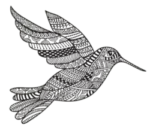

You almost always hear this bird before you see it. A male Broad-tailed Hummingbird in flight drags a loud metallic trill behind him, a sound closer to a cricket than to anything you would expect from a bird. It carries across a meadow. In the Colorado high country in June, that trill is the background noise of the whole season.
The Broad-tailed Hummingbird, Selasphorus platycercus, is the characteristic summer hummingbird of the mountain West. It nests higher than almost any other bird its size. It survives freezing nights at 10,000 feet on a body that weighs less than a nickel. It has also become one of the most closely studied hummingbirds in North America. Much of what science knows about hummingbird torpor, colour vision and climate mismatch was learned from this species.
How to Recognise a Broad-tailed Hummingbird
An adult male has a clean rose-magenta gorget, brighter and pinker than the deeper red of a Ruby-throated Hummingbird. Above it the crown and back are iridescent green. The flanks carry a light buff or cinnamon wash, and the tail is rounded and dark. As with every gorget, the colour vanishes the moment the light is wrong, because it is structural rather than pigmented.
Females and young birds are harder. Look for the white eye-ring, the speckled cheeks and the cinnamon on the flanks and at the base of the tail feathers. The eye-ring is the mark most birders settle on. Females are marginally larger than males, which is normal across the family.
The confusion risk is with the other western Selasphorus species. A male Rufous Hummingbird is orange across the back and flanks, so the green-backed Broad-tailed male is straightforward. Females of the two are genuinely difficult, and the types of hummingbirds in North America page sets out the full western cast for comparison.
Adults run about 4 inches long and weigh roughly 3.6 grams. Published mass ranges sit between 3 and 4 grams.
The Trill Is Not a Song
The trill is mechanical. It is not coming from the throat at all.
Airflow over the wing sets the tip of the outermost primary feather vibrating, and that vibration radiates as sound. The effect is called aeroelastic flutter, and it is the same physical principle that makes a blade of grass whistle between your thumbs. The hummingbird sounds article covers how widespread this trick is across the family.
Three things follow from the mechanism, and each one is useful in the field.
Only adult males make it. Females and immature males have unmodified outer primaries, so they fly past in silence. If a hummingbird buzzes past your ear in a Colorado meadow without a trill, that is information.
The sound wears out. Constant use abrades the feather tips over the season, and an abraded feather no longer flutters properly. By midwinter the trill has gone quiet. The male grows fresh primaries before the next breeding season, and the sound comes back with them.
It carries a long way. The trill is audible to other males at around 50 metres and to females at around 75 metres, which is the point of it. A male announcing himself continuously across a meadow is doing territorial work without having to fly to each boundary.
Separately from the flight trill, males perform a steep courtship dive, climbing high and dropping past a perched female. Cornell’s account notes that diving males will occasionally pin a female down into low vegetation. Hummingbird courtship is not a gentle business.
Where It Lives
The breeding range runs down the spine of the Rockies from Idaho and Montana into Colorado, Utah, Nevada, Arizona, New Mexico and west Texas. It reaches marginally into southern Wyoming and the Great Basin ranges. The hummingbirds of the Rocky Mountains guide covers where and when to look across that whole region. The Southwest guide picks the species up where the mountains break into the borderland canyons.
Elevation is the defining feature. Cornell gives a breeding band of roughly 5,000 to 10,500 feet, in meadows, open pinyon-juniper, pine-oak and montane scrub. Very few birds of any kind nest that consistently high. A bird weighing under four grams doing it is remarkable.
South of the US border the picture changes. Populations in southern Mexico and Guatemala are resident and do not migrate at all. The migratory northern birds winter in the highlands of central and southern Mexico.
Surviving the Mountain Night
A clear June night at 10,000 feet can fall below freezing. A 3.6-gram bird with a metabolism like this one’s cannot simply sit it out.
The answer is torpor. The bird drops its body temperature to around 54 degrees Fahrenheit once the air falls below about 44, cutting its fuel burn to a fraction of normal. It is not sleep. The bird is genuinely cold and takes time to warm back up at dawn. The how hummingbirds survive winter article covers the physiology in detail, and the where hummingbirds sleep page covers where they actually spend the night.
Broad-tailed males add a behavioural trick on top of the physiological one. On cold nights they move upslope to roost. Cold air drains downhill and pools in the valley bottoms overnight, so a perch a few hundred feet higher sits in measurably warmer air. Cornell reports that the move cuts the bird’s thermoregulation costs by roughly 15 percent. That is a large saving for the price of a short flight.
Migration
Northern breeders arrive in the southern Rockies from late April, and in the Colorado high country through May as the snow retreats. The higher the meadow, the later they appear. Departure begins in late July for males and runs through August and into September for females and young birds, which is the same sex-staggered pattern seen in hummingbird migration generally.
They migrate overland through the mountain corridors rather than crossing the Gulf. Many follow a loop, moving north through the lowlands in spring and drifting south along the high meadows in late summer as the wildflowers peak there.
Nesting
The female does all of it. She builds, she incubates, she feeds the young, and she does it without any contribution from the male, which is standard across North American hummingbirds.
She sets the nest on a horizontal branch with cover overhead, often on an evergreen or aspen, or low in a willow or alder thicket. Typical height is 1 to 5 feet above the ground. The cup is bound with spider silk and gossamer, which insulates it and lets the walls stretch as the nestlings grow. Lichen, moss and bark fragments on the outside hide it completely. Building takes four or five days. The architecture of hummingbird nests page covers the construction in more detail.
Females will sometimes repair an old nest from a previous season and use it again, adding fresh material rather than starting over. In a place where the snow-free window is short, saving several days matters.
The clutch is two white unmarked eggs. Incubation runs 16 to 19 days, and the young leave the nest a further 21 to 26 days after hatching.
What It Eats
Nectar comes mainly from red and tubular mountain wildflowers. Scarlet gilia, Indian paintbrush, larkspur, red columbine and sage are all regular sources. During spring migration, before the summer meadow flowers open, the birds rely on pussy willow, currant and glacier lily.
Insects matter more than most people assume. Adults take small insects and spiders on the wing and from foliage, and nestlings are fed almost entirely on them. Nectar is the fuel, but protein builds the bird. The what hummingbirds eat article sets out how the two halves of the diet fit together.
Males defend rich feeding territories hard. One male was recorded making more than forty chases in a single hour to hold a patch containing feeders. That level of aggression is normal, not exceptional, and it is why a single dominant bird can monopolise a garden.
The Bird That Proved Hummingbirds See Colours We Cannot
In 2020 a team led by Mary Caswell Stoddard published a set of field experiments carried out on wild Broad-tailed Hummingbirds in Colorado. The birds were trained to associate particular LED colours with a sugar reward.
The finding was that they could reliably tell apart colour mixtures combining ultraviolet with a visible wavelength. Ultraviolet-plus-green, for instance, is a colour with no equivalent in human vision at all. We have no name for it because we cannot see it. The what colours hummingbirds see article explains the fourth cone type that makes this possible, and what it means for how a flower looks to a bird.
It is worth pausing on the fact that this was done on wild birds, in a meadow, with birds free to leave at any point.
How Long They Live
The average is short and the ceiling is surprisingly high.
Banding data give an average wild lifespan of about 1.75 years. Most of that is driven by first-year mortality, which is brutal across all hummingbirds. Survive to adulthood and the picture improves considerably.
The record holder is a female banded in Colorado in 1976 and recaptured there in 1987. She was at least twelve years and two months old. That is the oldest Broad-tailed Hummingbird ever documented, and among the oldest hummingbirds of any species on record. She turned up in the recapture data because the Colorado study population had been banded and re-banded for years, which is the only reason anyone knows she existed. The how long hummingbirds live article explains why banding is the only honest source for these figures.
Long-term work at the same Colorado site found female return rates running as high as 70 percent between years, against roughly 27 percent for males. Some of that gap is genuine survival difference and some of it is males being harder to recapture.
The Squeeze
The Broad-tailed Hummingbird is listed as Least Concern by the IUCN, and it is not a rare bird. The trend, though, is not good.
Breeding survey data indicate a decline of roughly 45 percent between 1966 and 2019, and the species now sits on Partners in Flight’s Yellow Watch List. A 2021 analysis of long-term banding records found the decline continuing, with the rate steepening in the most recent decade examined. The same study found the birds themselves getting measurably smaller, which is a response seen in a number of species as temperatures rise.
The mechanism behind the pressure is well documented at one Colorado site, and it is a timing problem rather than a habitat one.
Glacier lily is one of the first nectar sources available after snowmelt, and it matters disproportionately to birds arriving hungry. A study published in Ecology in 2012 compared four decades of hummingbird arrival dates against four decades of first flowering dates. Snowmelt is coming earlier, so the lily is flowering earlier. The birds are also arriving earlier, but not as fast.
The gap between the two has widened by around thirteen days over the period studied. Projected forward, the authors calculated that the birds would begin arriving after the average first flowering date within a few decades. A hummingbird that arrives to find the early flowers already finished has to fly further and burn more to find fuel. That happens at exactly the point in the year when it has least in reserve.
This is the same pattern turning up across the family, and the threats to hummingbirds article covers the wider picture.
Attracting Broad-tailed Hummingbirds
If you live in the mountain West within the breeding range, this is a realistic garden bird.
Put feeders out in late April at lower elevations and in May higher up, following the local timing set out in the when to put out hummingbird feeders article. Use plain white sugar in a 1:4 ratio with water, and nothing else. The nectar recipe and feeder care page covers cleaning schedules, which matter more at altitude in summer heat than most people realise.
Plant for them as well. Scarlet gilia, penstemon, columbine and paintbrush are all native, all used by the birds, and all better long-term value than a feeder. The how to attract hummingbirds article covers planting and placement together.
Expect one male to try to own the whole thing. Two or three widely spaced feeders, out of sight of each other, will let more birds feed than one busy one.
Frequently Asked Questions
What is the trilling sound a hummingbird makes? In the mountain West it is almost certainly a male Broad-tailed Hummingbird. The sound is produced by airflow fluttering the tip of his outermost wing feather, not by his voice. Only adult males make it.
How do you tell a Broad-tailed from a Rufous Hummingbird? Males are easy. A Broad-tailed male has a green back and a rose-magenta throat; a Rufous male is orange across the back and flanks. Females of the two are genuinely difficult and often go unidentified.
How high do Broad-tailed Hummingbirds nest? Up to about 10,500 feet. The breeding band runs from roughly 5,000 feet upward, which makes this one of the highest-nesting birds of its size anywhere.
Do Broad-tailed Hummingbirds migrate? The northern population does, wintering in the highlands of central and southern Mexico. Populations resident in southern Mexico and Guatemala stay put all year.
How long do Broad-tailed Hummingbirds live? The average is under two years, pulled down by heavy first-year mortality. The oldest on record was a female of at least twelve years and two months, banded and recaptured in Colorado.
Why does the wing trill go quiet in winter? The feather tips that produce it wear down with use. A worn feather no longer flutters, so the sound fades. Fresh feathers grown before the breeding season restore it.
Conclusion
The Broad-tailed Hummingbird is the sound of a mountain summer, and it is also one of the best-documented small birds on the continent. Torpor, colour vision, longevity and climate mismatch have all been worked out on this species, largely at one Colorado field station. That research is now telling us the bird is in trouble, slowly and from a high base. The trill across a June meadow is worth listening to while it is still that easy to hear.
Quiz: The Broad-tailed Hummingbird
The questions in this quiz are grounded in the published research and reference sources listed below:
Source for the torpor figures, the upslope roosting behaviour, the wearing down of the trill feathers over winter, and the banding record of a female that was at least twelve years and two months old.
Covers the breeding elevation band, clutch size, incubation and nestling periods, nest construction and reuse, the plants the birds feed from, and the population trend since 1966.
University of Michigan Museum of Zoology account, giving the mass and length ranges, the elevation range across the whole year, and the average wild lifespan drawn from long-term banding studies.
The study behind the glacier lily mismatch, comparing four decades of hummingbird arrival dates and first flowering dates at a long-term Colorado study site.
Analysis of long-term banding data showing a continuing decline and a measurable shrinking of body size, with the rate of decline steepening in the most recent decade examined.
Field experiments carried out on wild Broad-tailed Hummingbirds in Colorado, demonstrating that the birds can tell apart colour mixtures that combine ultraviolet with a visible wavelength.
The full scholarly species account, covering taxonomy, the resident populations in southern Mexico and Guatemala, display behaviour and the sound produced by the wings in flight.
Field guide account describing the plumage of both sexes, the habitats the species uses in the mountain West, and the timing of its movements through the region.