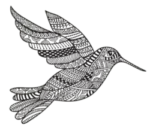

Allen’s Hummingbird is one of the most threatened hummingbirds in North America. It is also one that has colonised a major city within living memory.
Both statements are true. They describe different birds wearing the same name.
The species comes in two forms. One migrates, and it is in serious trouble. The other stays put, and it is thriving so comprehensively that it has spread across southern California from a standing start. Almost every published figure about Allen’s Hummingbird is really a figure about one of them, and knowing which is the difference between understanding this bird and misreading it.
Quick Facts
Scientific name: Selasphorus sasin
Subspecies: S. s. sasin, migratory; S. s. sedentarius, resident
Length: about 3.5 inches
Wingspan: about 4.3 inches
Weight: 2 to 4 grams
Range: coastal California and southern Oregon in the breeding season; the resident subspecies is year-round across southern California
Longevity record: a female of at least 5 years and 11 months, banded in California in 2004 and recaptured there in 2009
Population: around 1.5 million
Conservation status: Red Alert Tipping Point species, down 77 percent since 1968, and 17 out of 20 on the Continental Concern Score
Two Allen’s Hummingbirds
Selasphorus sasin sasin is the migratory one and the bulk of the species. It breeds in a narrow coastal strip from southern Oregon down through California, arriving remarkably early, and winters in a small area of Mexico. This is the bird behind the decline figures.
Selasphorus sasin sedentarius was, until recently, a Channel Islands bird and nothing else. It does not migrate. At some point before 1966 it reached the mainland at the Palos Verdes Peninsula, and it has been spreading ever since.
They look essentially the same in the field. The difference is behavioural and geographic, not visual, which is part of why the two stories get blended into one.
How to Identify an Allen’s Hummingbird
The adult male is a striking bird: a deep reddish-orange gorget, a coppery tail, eye patch and belly, and a bronze-green back. The bill is straight and about as long as the head. The tail extends past the wings when perched, and the outermost tail feather is narrower than the rest.
That last detail is the one that matters most, for reasons the next section explains.
Females and immatures are bronze-green above with paler coppery sides, some spotting on the throat and often a small patch of reddish orange in the centre of it. The structural physics behind that orange flash is the same as in every gorget: it fires at one angle and goes dark at the rest.
The Rufous Problem
This is one of the genuinely difficult identifications in North American birding, and it deserves an honest answer.
For adult males, the back is the shortcut. A male with a bronze-green back is an Allen’s. A male with a solidly coppery-rufous back is a Rufous. Birders use the rule that a back less than half green can safely be called a Rufous without seeing the tail.
The complication runs in one direction. Some adult male Rufous show green on the back, so green is not by itself conclusive. Once green passes the middle of the back, the shortcut fails and the tail becomes the test. Allen’s outer tail feathers are narrow, Rufous outer tail feathers are broad. It is visible on a flying bird if the tail spreads, and it is not easy.
For females and immatures, be honest with yourself. They are very nearly identical, and reliable separation needs a clear view of the spread tail that most garden observations never provide.
Range does more work than plumage. Allen’s breeding range is a narrow coastal strip, so away from it a Selasphorus hummingbird is far more likely to be a Rufous. Inside southern California, the reverse applies: a year-round Selasphorus in a Los Angeles garden is almost certainly a resident Allen’s, because Rufous do not stay.
The article on North American species sets out the whole cast, and the California article covers where and when across the state.
Range and Habitat
The migratory subspecies breeds in coastal forest, scrub and chaparral from sea level to around 1,000 feet, in a strip running from southern Oregon down the California coast. Males hold more open territory while females favour areas with tree cover. It is one of the earliest breeders of any North American hummingbird, with birds on territory in the first weeks of the year. It winters in a small part of Mexico.
The resident subspecies now occupies a large part of urban and suburban southern California, and did not until recently.
The Pacific Northwest article covers the northern edge of the breeding range, where Allen’s and Rufous overlap and the identification problem is at its worst.
The Colonisation of Southern California
This is the part of the story almost nobody tells, and it is documented precisely.
Christopher Clark analysed eBird records and published the result in The Condor in 2017. Before 1966 the resident subspecies was confined to the Channel Islands. In June of that year, fledglings were noticed being fed near San Pedro on the Palos Verdes Peninsula, on the mainland.
What followed was one of the better-documented range expansions in North American birds.
| Then | Now | |
|---|---|---|
| Mainland range | about 70 km² in 1970 | about 13,000 km² |
| Mainland population | roughly 490 to 3,780 birds | 46,000 to 350,000 |
That is roughly a 9,200 percent increase in area over 45 years, which Clark calculates as a sustained annual growth rate of about 10 percent.
The spread can be tracked town by town. Orange County in 1996. Pasadena in 1998. Claremont in 2000. San Diego in 2001. Santa Barbara in 2005. Riverside in 2008. Temecula in 2012.
The driver appears to be the same one behind Anna’s Hummingbird’s northward march: ornamental garden planting and year-round feeders creating habitat where none existed. A bird that does not need to migrate can exploit that completely.
The Decline
Now the other half, and it is grim.
The 2025 State of the Birds report lists Allen’s Hummingbird as a Red Alert Tipping Point species. That is the most severe category, and it is a step worse than the Orange Alert given to the Rufous.
Breeding Bird Survey data show a decline of 2.6 percent a year between 1968 and 2023, a cumulative loss of 77 percent. Partners in Flight estimates 1.5 million birds remain and scores the species 17 out of 20 on the Continental Concern Score. That is the highest score of any hummingbird covered on this site.
Set against the others, the picture is stark.
| Species | Cumulative decline | Concern score | Tipping Point |
|---|---|---|---|
| Allen’s | 77% | 17 of 20 | Red Alert |
| Rufous | 72% | 14 of 20 | Orange Alert |
| Calliope | stable | 14 of 20 | Yellow Watch List |
| Black-chinned | increasing | 9 of 20 | none |
Those aggregate numbers are dominated by the migratory subspecies, because it is much the larger population. The resident birds, growing at 10 percent a year, are not enough to offset it. A species can be expanding in one place and collapsing overall, and this one is.
The causes are the familiar coastal ones. Habitat loss and fragmentation along a narrow, heavily developed strip of California sit alongside the climate pressures covered in the threats to hummingbirds article. A bird whose entire breeding range is a thin coastal band has nowhere to retreat to.
The Dive
The male’s display is a two-part performance. He swings back and forth in pendulous arcs in front of the female, then climbs high and dives, producing a sharp squeal from his tail feathers on the way down.
The sound is mechanical rather than vocal, the same sonation trick used across the family. It is covered further in the article on how hummingbirds make sound.
Breeding
The female does everything, as in every hummingbird species.
She nests in trees or shrubs anywhere from 2 to 50 feet up, which is the widest placement range of any hummingbird on this site. Incubation runs 17 to 22 days, and the young leave the nest 22 to 25 days after hatching. She may raise one to three broods in a season.
Those periods are notably long. A Calliope incubates in 15 to 16 days and fledges in 18 to 21. Allen’s takes roughly a week longer at both stages, which is a real difference for a bird of the same size. The full breeding cycle is covered separately, and how long the survivors go on to live is a separate question again.
What It Eats
Nectar comes from bush monkeyflower, Indian paintbrush and columbine among others, with small insects taken in flight or gleaned from vegetation supplying the protein. The balance between nectar and insects works much as it does across the family.
Like all hummingbirds it uses torpor to get through cold nights, though the coastal climate it occupies makes lighter demands than the mountains do on a Broad-tailed or a Calliope.
Attracting Allen’s Hummingbirds
If you are in coastal California, this is a realistic garden bird, and in southern California it may be a year-round one.
Put feeders out very early. The migratory subspecies is on territory in the first weeks of the year, well before most people think about hummingbirds. Use plain white sugar at one part to four parts water and nothing else, and clean the feeder often, which the nectar recipe and feeder care page covers in detail.
Plant California natives. Bush monkeyflower, columbine, currant and sages all work, and they outlast any feeder. The article on attracting hummingbirds covers planting and placement, and when to put feeders out and take them down covers timing.
There is a conservation argument here that applies to few other species. Garden habitat is demonstrably what allowed the resident subspecies to expand across southern California. For a Red Alert bird, what you plant is not decoration.
Frequently Asked Questions
How do I identify an Allen’s Hummingbird?
Adult males have a bronze-green back with a deep reddish-orange gorget, coppery tail and belly. Females and immatures are bronze-green above with coppery sides and often a small orange throat patch. The outermost tail feather is narrow, which is the key separation from Rufous.
How do I tell an Allen’s from a Rufous Hummingbird?
For adult males, a green back means Allen’s and a solidly coppery back means Rufous, though some male Rufous do show green. Beyond that it comes down to the spread tail: narrow outer feathers on Allen’s, broad on Rufous. Females and immatures are nearly identical.
Are there two kinds of Allen’s Hummingbird?
Yes. S. s. sasin migrates between coastal California and Mexico. S. s. sedentarius stays in southern California year-round. They look the same in the field.
Is the Allen’s Hummingbird endangered?
Not formally listed, but it is in serious trouble. The 2025 State of the Birds report calls it a Red Alert Tipping Point species, the most severe category, after a 77 percent decline between 1968 and 2023.
If it is declining, why are there so many in Los Angeles?
Because those are resident birds of a different subspecies, which has expanded from the Channel Islands across southern California since the 1960s. Its mainland range has grown from about 70 square kilometres to around 13,000. The overall species decline is driven by the migratory population.
When do Allen’s Hummingbirds arrive?
Very early. The migratory subspecies is on breeding territory in the first weeks of the year, earlier than almost any other North American hummingbird.
Conclusion
Allen’s Hummingbird is the clearest case on this site of why a single population number can mislead. Read the aggregate and you get a bird in freefall, and that is true. Walk through a garden in Pasadena and you get a bird that has made itself at home in a city outside its range sixty years ago. That is also true.
The lesson is not that the decline is overstated. It is that the thing keeping one half of this species going, ordinary planted gardens, is the one lever available to almost anybody. For a Red Alert bird, that is worth knowing.
Quiz: The Allen’s Hummingbird
The questions in this quiz are grounded in the published research and reference sources listed below:
The paper documenting the mainland colonisation: fledglings at Palos Verdes in 1966, a range that grew from about 70 square kilometres in 1970 to around 13,000 today, and a sustained annual growth rate near 10 percent.
Broods, incubation and nestling periods, nest placement, coastal habitat and diet, plus the conservation figures: a 2.6 percent annual decline from 1968 to 2023, a cumulative loss of 77 percent, and a Continental Concern Score of 17 out of 20.
The measurements and field marks, including the bronze-green back of the adult male, the coppery tail and belly, and the narrow outermost tail feather that separates this species from the Rufous.
The two subspecies and their different habits, the banding record of a female at least five years and eleven months old, and the pendulous display arcs followed by a diving squeal made with the tail.
Lists Allen’s Hummingbird as a Red Alert Tipping Point species, the most severe category, a step above the Orange Alert assigned to the Rufous Hummingbird.
Examines the genetic consequences of the resident subspecies’ move from the Channel Islands onto the southern California mainland.