Hummingbirds can see colours that are completely invisible to us, including ultraviolet shades that blend with reds, greens and yellows to create hues beyond human imagination. While our eyes detect only three colour channels, hummingbirds have four, giving them access to a visual world so rich that leading researchers have put it plainly: humans are colour-blind compared to birds. This guide covers exactly what hummingbirds can see, how the system works, and why it matters for the flowers they visit, the mates they choose and the territories they defend.
How Hummingbirds See Colour
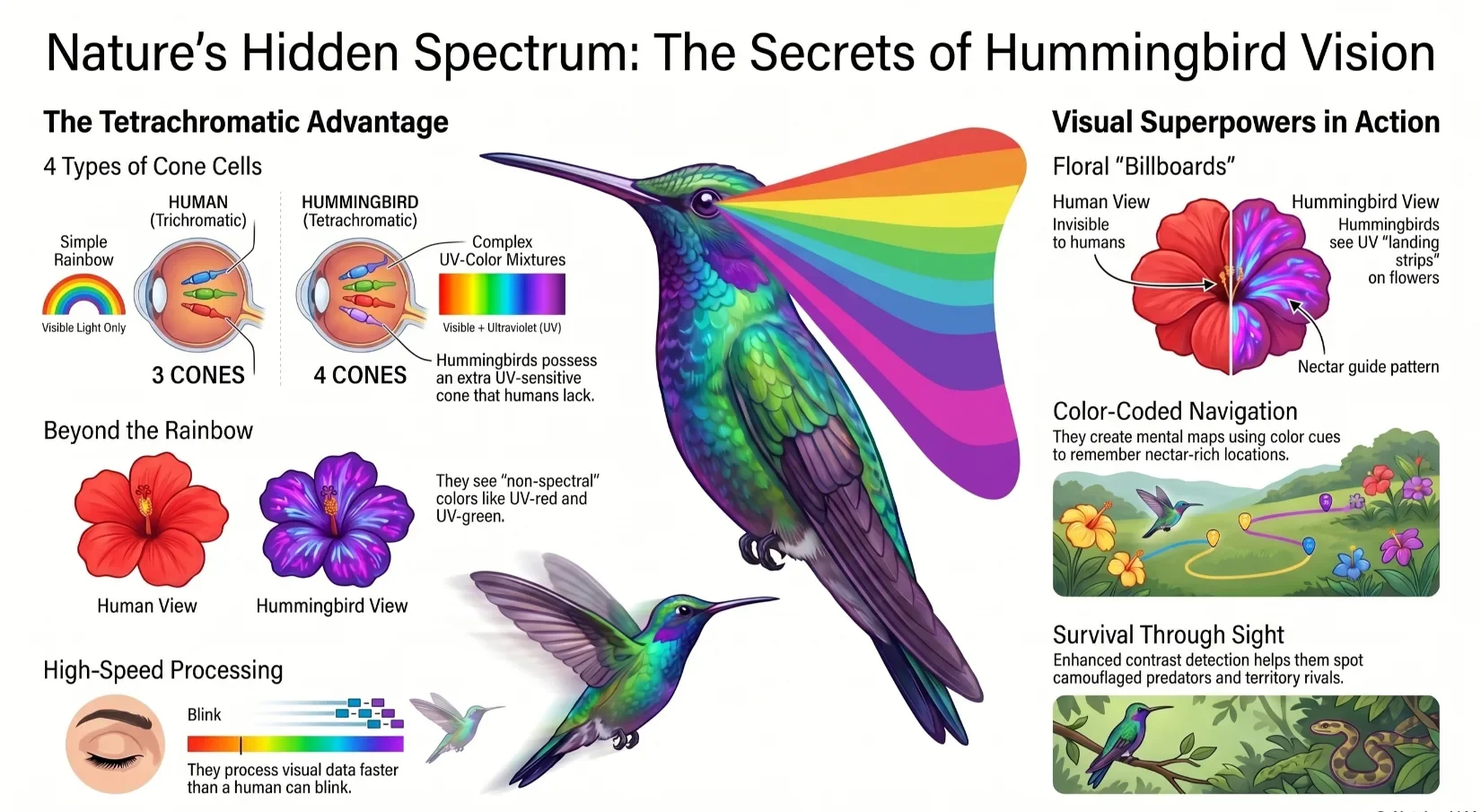
Like humans, hummingbirds rely on light-sensitive cells called cones, but where we have three types, they have four. Our three are tuned to red, green and blue. Hummingbirds have all three of those plus a fourth sensitive to ultraviolet. This four-cone system is called tetrachromatic vision, and it does not merely extend the range of colours detected; it multiplies the number of combinations that can be distinguished.
Think of it as dials. Our three cones are three dials, each measuring one channel. When we perceive purple, our blue and red cones fire while green largely does not, and that combination produces the experience of purple, our single non-spectral colour. Hummingbirds run four dials at once, opening a far larger space of possible combinations. Where humans have one non-spectral colour, birds potentially have up to five: purple, UV+red, UV+green, UV+yellow and UV+purple. Four of those are colours our visual system simply cannot produce.
Tetrachromacy is not unique to hummingbirds. It is shared by most birds, many fish and reptiles, and is thought to have been present in dinosaurs. Mammals, including us, lost two of the original four cone types during an early nocturnal phase of evolution and never regained them. This is one of the more striking entries in the longer list of ways hummingbirds differ from other birds.
The Oil Droplet Advantage
Here is a detail even many birdwatchers do not know: hummingbirds do not rely on their four cone types alone. Each cone contains a small coloured oil droplet, a microscopic lens of pigmented oil that filters light before it reaches the photosensitive cell behind.
These droplets sharpen discrimination by narrowing the band of wavelengths each cone responds to. An unfiltered cone responds broadly, which makes neighbouring colours harder to tell apart. A filtered cone responds to a narrower, more specific band, making fine distinctions more precise. It is roughly the difference between a camera with and without a colour-correcting filter.
The result is that hummingbird colour vision is finer-grained than the cone count alone suggests. These birds are not just detecting more colours than us; they are distinguishing between similar hues with a precision we cannot match.
The Fourth Dimension: UV Vision Explained
The UV-sensitive fourth cone opens an entirely different category of experience. Ultraviolet light sits just beyond the violet end of the visible spectrum, invisible to humans but well within a hummingbird’s range.
What makes this more than an extended range is that hummingbirds perceive combinations of UV with other colours. When UV and red stimulate their respective cones simultaneously, the bird perceives something with no equivalent in human experience: not red, not UV, but a product of both. The same applies to UV+green, UV+yellow and UV+purple.
These are not simply brighter or more saturated versions of familiar colours. They are genuinely new points in a colour space with an additional dimension, one we lack the neurological architecture to access. As Ben Hogan, a Princeton researcher on the 2020 study, put it: it is impossible to really know how the birds perceive these colours, and whether ultraviolet plus red is a mix of those colours or something entirely new remains a matter of speculation.
Non-Spectral Colours: The Hues Only Hummingbirds See
A non-spectral colour is one that no single wavelength of light can produce. It exists only as a perception created when multiple cone types are stimulated at once. In human vision, purple is the sole example: it arises when our red and blue cones both fire, though no monochromatic light, such as from a rainbow, produces it.
Because hummingbirds have that fourth cone, they can form non-spectral perceptions involving UV in combination with visible wavelengths, colours with no name in any human language because no human has ever seen them. Researchers identify five non-spectral categories available to hummingbirds: purple, UV+red, UV+green, UV+yellow and UV+purple. The last four are entirely beyond us.
The scale of the difference becomes clearer from the study’s own analysis. Examining 965 bird plumage spectra and 2,350 plant spectra, the researchers found that roughly 30 percent of plumage colours and around 35 percent of plant colours would appear non-spectral to a hummingbird.
Then they ran the same two datasets through a model of human vision. For us, the figures fall to 7 percent of those plumage colours and 19 percent of the plant colours. Looking at the same meadow, a hummingbird sees roughly four times as many feather colours in a category we barely have access to at all. The gulf is far wider than most people would guess.
How Scientists Proved It: The Rocky Mountain Experiment
Knowing hummingbirds possess a UV-sensitive cone is one thing. Proving their brains use it to perceive genuinely new colours, rather than merely registering UV as extra brightness, required something more ingenious.
The proof came from a study led by Mary Caswell Stoddard at Princeton, published in the Proceedings of the National Academy of Sciences in June 2020, with collaborators from the University of British Columbia, Harvard, the University of Maryland and the Rocky Mountain Biological Laboratory.
Their field site was that laboratory in Gothic, Colorado, a high-altitude meadow at nearly 10,000 feet home to large numbers of wild Broad-tailed Hummingbirds, the signature species of the Rockies. Each morning the team rose before dawn and set out two feeders, one of sugar water and one of plain water. Beside each stood a custom-built LED tube able to display colours across the visible and UV spectrum, including combinations like UV+green that conventional lights cannot produce.
The critical test: could hummingbirds tell UV+green from plain green, two colours identical to human eyes, and learn to choose the one paired with the reward?
Within hours, they could. Wild birds that had never seen these lights repeatedly selected the UV+green tube. When the researchers switched which colour carried the reward, the birds switched too, demonstrating they perceived UV+green as a distinct colour rather than as extra brightness. The team also ran the harder version of the test, pairing two different shades of the same non-spectral colour against each other, and the birds still chose correctly well above the fifty percent that chance would predict.
The experiments confirmed discrimination of four non-spectral colours: UV+red, UV+green, purple and UV+yellow. The fifth category, UV+purple, is thought to be available to them but was not among those tested.
Can Hummingbirds See Red? Why It Captures Their Attention
Yes, and vividly. Red wavelengths appear especially strong to hummingbirds, which is why red feeders and red blooms attract them so reliably. But the relationship is more nuanced than simple preference.
Many flowers that look uniformly red to us carry ultraviolet patterns invisible to human eyes, nectar guides that direct the bird precisely to the reward. What we see as a plain red trumpet may appear to a hummingbird as a red bloom with a distinct UV bullseye at its centre. The flower did not merely evolve to be red; it evolved to be red and UV-patterned, specifically to communicate with pollinators that see both.
The preference for red is also partly an accident of co-evolution. Red is poorly visible to many insects, particularly bees, which are trichromats sensitive to UV, blue and green but relatively insensitive to red. A red, UV-patterned flower is effectively a hummingbirds-only signal: conspicuous to its preferred pollinator and largely invisible to competitors. Plants using this strategy were pollinated more successfully, and the birds visiting them got reliable rewards.
This has a practical consequence worth knowing: since the red on a feeder is what draws the bird, red dye in the nectar itself serves no purpose. Our nectar recipe and feeder guide explains why. For choosing flowers that do this work naturally, see our guide to attracting hummingbirds.
Why Bright Flowers Attract Hummingbirds
For a hummingbird, a flower is not just a bloom. It is a complex visual advertisement, and the information it encodes goes well beyond colour.
Hummingbirds read floral colour as a signal of nectar quality and availability. Freshly opened flowers with full nectar loads tend to display colour at peak intensity, and some flowers physically change colour after pollination, a visual closed sign that saves both parties a pointless interaction.
UV patterns add another layer. Rather than advertising simply “nectar here,” a UV nectar guide says “nectar here, at exactly this spot.” That precision cuts handling time for the bird, meaning more flowers visited per unit of energy, and it improves the odds that the bird’s head contacts the pollen-bearing parts, which serves the plant. Why that efficiency matters so much is a question of energy budgets, covered in our article on what hummingbirds eat.
How Hummingbirds Use Colour to Communicate
Colour is not only a tool for finding food. It is the primary language of hummingbird social life, and much of that language is written in UV.
The iridescent gorget feathers of males produce their colour through structural coloration rather than pigment. Microscopic platelet structures reflect and refract light, producing colours that shift dramatically with viewing angle. This makes the gorget a dynamic signal rather than a static badge: a male actively manages the angle of his head relative to an observer and to the sun to maximise the flash during threat and courtship encounters. The physics behind it is covered separately.
Crucially, many gorget colours that read as simply red or magenta to us reflect UV strongly, meaning other hummingbirds perceive them as UV+red or UV+purple, carrying information about health and genetic quality our eyes cannot read. The 2020 study found that the magenta throat feathers of a male Broad-tailed Hummingbird likely appear to other hummingbirds as an ultraviolet-plus-purple combination.
So the full social complexity of hummingbird life, mate assessment, territorial signalling and dominance display, is happening partly in a channel entirely invisible to a human observer standing a few feet away. The behaviour that goes with those signals is covered in our article on sounds and territorial behaviour, and the courtship it serves in another again.
How Colour Vision Helps Them Navigate
A hummingbird’s foraging route is not random. These birds build detailed cognitive maps of their territories, tracking not just where food is but which flowers are worth visiting and when they will have refilled. Colour is central to that memory system.
Colour signatures associated with reliable nectar sources are encoded alongside location, linking a specific pattern in a specific place with reward. When a hummingbird returns to a patch it visited yesterday, it is navigating toward a remembered visual landmark that includes UV information no human observer can see. The same spatial memory works at continental scale during migration, returning individuals to the same gardens year after year.
This is also why hummingbirds become such reliable feeder visitors. A consistently stocked feeder is remembered not merely as “the red object near the fence” but as a specific visual signature including any UV reflectance from its surfaces, a detail neither the manufacturer nor the gardener is likely aware they have advertised.
Frequently Asked Questions
What colours can hummingbirds see?
Everything humans see, plus ultraviolet, plus non-spectral combinations with no equivalent in human experience: UV+red, UV+green, UV+yellow and UV+purple, alongside purple which we share. Four cone types plus filtering oil droplets make their perception considerably richer than ours.
Can hummingbirds see UV light?
Yes. A fourth cone type is specifically sensitive to ultraviolet, and they also perceive combinations of UV with visible wavelengths as distinct hues.
Do hummingbirds see red?
Yes, and vividly. Many red flowers also carry UV patterns invisible to us that act as nectar guides, making them more conspicuous still.
What is tetrachromatic vision?
Having four cone types rather than three. The fourth adds an entire dimension to colour perception, enabling UV detection and UV combinations that a three-cone system cannot produce.
What are non-spectral colours?
Perceptual hues no single wavelength can produce, arising when non-adjacent cone types are stimulated together. Purple is the only one humans perceive; hummingbirds have access to several more.
How much more of the world looks non-spectral to a hummingbird?
Roughly four times as much, for feather colours. Analysing the same 965 plumage spectra, researchers estimated about 30 percent would appear non-spectral to a hummingbird against just 7 percent to a human. For plant colours the split is about 35 percent against 19.
How was this proven?
Three years of field experiments at the Rocky Mountain Biological Laboratory using custom LED tubes. Wild Broad-tailed Hummingbirds learned to distinguish UV+green from plain green, identical to human observers, by associating it with a sugar-water reward.
Conclusion
The next time a hummingbird hovers at your feeder, it is worth pausing to consider that the bird is perceiving your garden in colours you will never see: reading UV signals in your flowers, catching UV reflections in nearby plumage, and navigating by a colour-coded map of its territory entirely invisible to you. It is seeing a world layered on top of ours, and it has been doing so for tens of millions of years.
Quiz: What Colors Can Hummingbirds See?
The quiz questions are grounded in peer-reviewed research and reporting from the sources below:
The primary study. Confirms wild hummingbirds discriminate UV+red, UV+green, purple and UV+yellow. Its analysis of 965 plumage spectra and 2,350 plant spectra found roughly 30 percent and 35 percent respectively would appear non-spectral to a bird, against just 7 percent and 19 percent to a human.
Open-access full text of the same paper, including the experimental design, the LED tube apparatus, and the colour-space modelling behind the plumage and plant analysis.
The lead institution’s account of the three summers of fieldwork at the Rocky Mountain Biological Laboratory, and Mary Caswell Stoddard on what the results do and do not tell us.
Co-investigator institution summary, including Harold Eyster on watching wild birds reliably pick the UV+green tube that looked identical to the researchers.
A researcher-written walkthrough of the experimental logic, including the paired tests of non-spectral against spectral colours and of two shades of the same non-spectral colour, and why performance well above 50 percent rules out chance.
Accessible overview covering cone types, the non-spectral findings, and Stoddard’s caution that what these colours actually look like to a bird remains beyond our reach.